
Types of Curtains: 30+ Styles, Fabrics and Uses for UAE Homes

In a Dubai summer, the sun rises at about 5:30 am. It pours through big glass windows and heats up your room before breakfast. In a high-rise, your neighbours in the next tower can often see straight in.
The right curtain fixes all of this. The wrong one fades in a year, leaks light, or simply looks out of place.
This guide explains all the main types of curtains in plain words. You will learn their names, see how each one works, and find the best choice for every room in a UAE home.
Curtains come in four main groups. By function: sheer, dim-out, blackout, thermal and acoustic. By heading style: wave, pinch pleat, pencil pleat, eyelet, rod pocket and tab top. By fabric: polyester, linen, cotton, velvet and silk. By length: sill, apron, floor-length and puddle.
Types of Curtains at a Glance
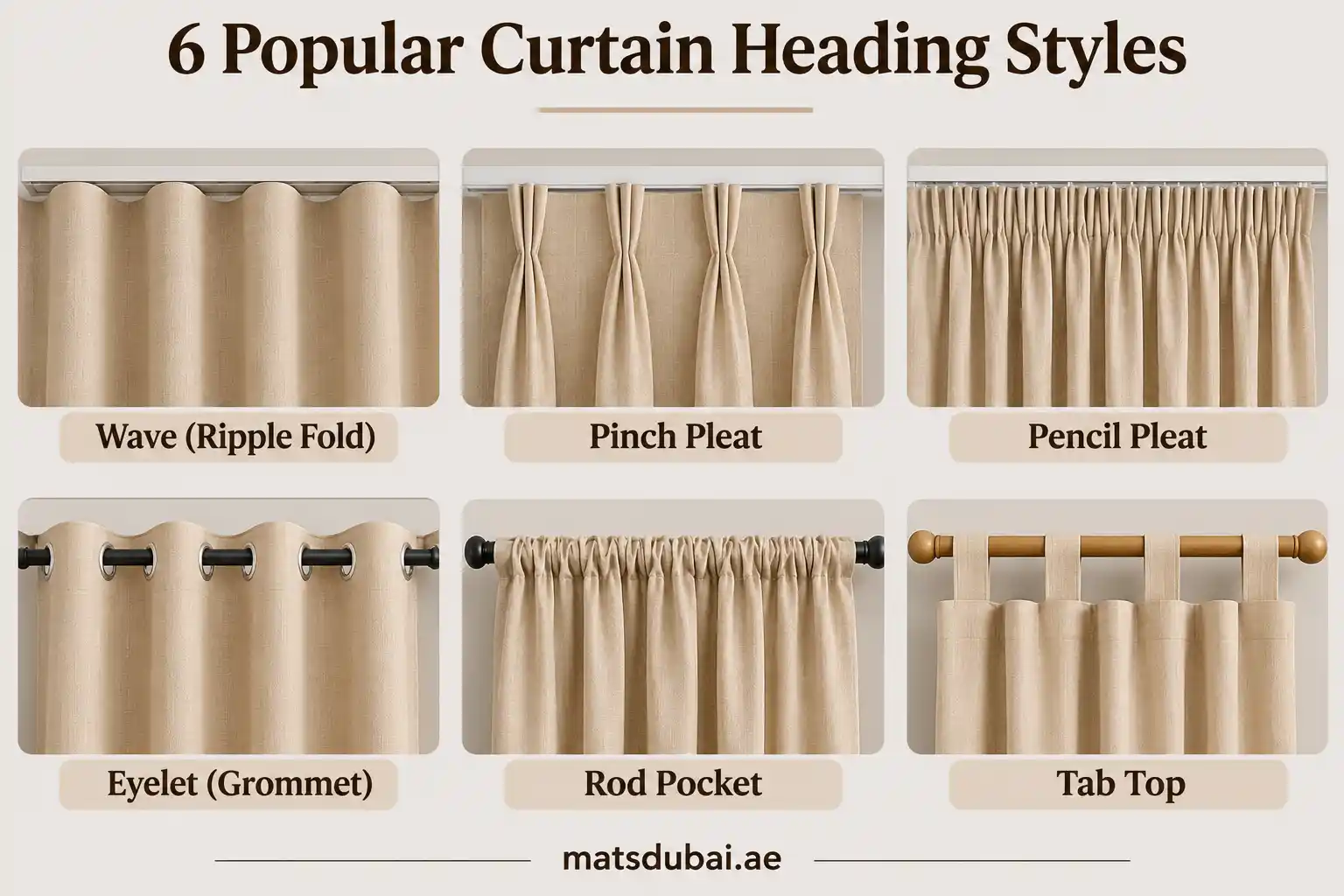
Use this table to find a curtain type fast. Each type is explained in detail further down.
| Curtain type | Group | Light control | Best rooms | Look |
| Sheer curtains | Function | Low | Living room, dining | Light and airy |
| Dim-out curtains | Function | High | Living room, office | Soft and calm |
| Blackout curtains | Function | Full | Bedroom, nursery, TV room | Clean and cosy |
| Thermal curtains | Function | High | West-facing rooms | Practical |
| Day and night curtains | Function | Flexible | Bedroom, living room | Layered and rich |
| Wave (ripple fold) curtains | Heading | Depends on fabric | Apartments, modern villas | Modern |
| Pinch pleat curtains | Heading | Depends on fabric | Living room, majlis | Classic and formal |
| Pencil pleat curtains | Heading | Depends on fabric | Bedroom, family room | Soft and traditional |
| Eyelet (grommet) curtains | Heading | Depends on fabric | Bedroom, kids room | Casual and modern |
| Rod pocket curtains | Heading | Depends on fabric | Guest room, dining | Gathered and simple |
| Tab top curtains | Heading | Depends on fabric | Sunroom, kitchen | Relaxed and rustic |
| Café curtains | Length | Partial | Kitchen, bathroom | Charming |
| Motorised curtains | Operation | Any | Villas, high windows | Smart and premium |
Types of Curtains by Function and Light Control
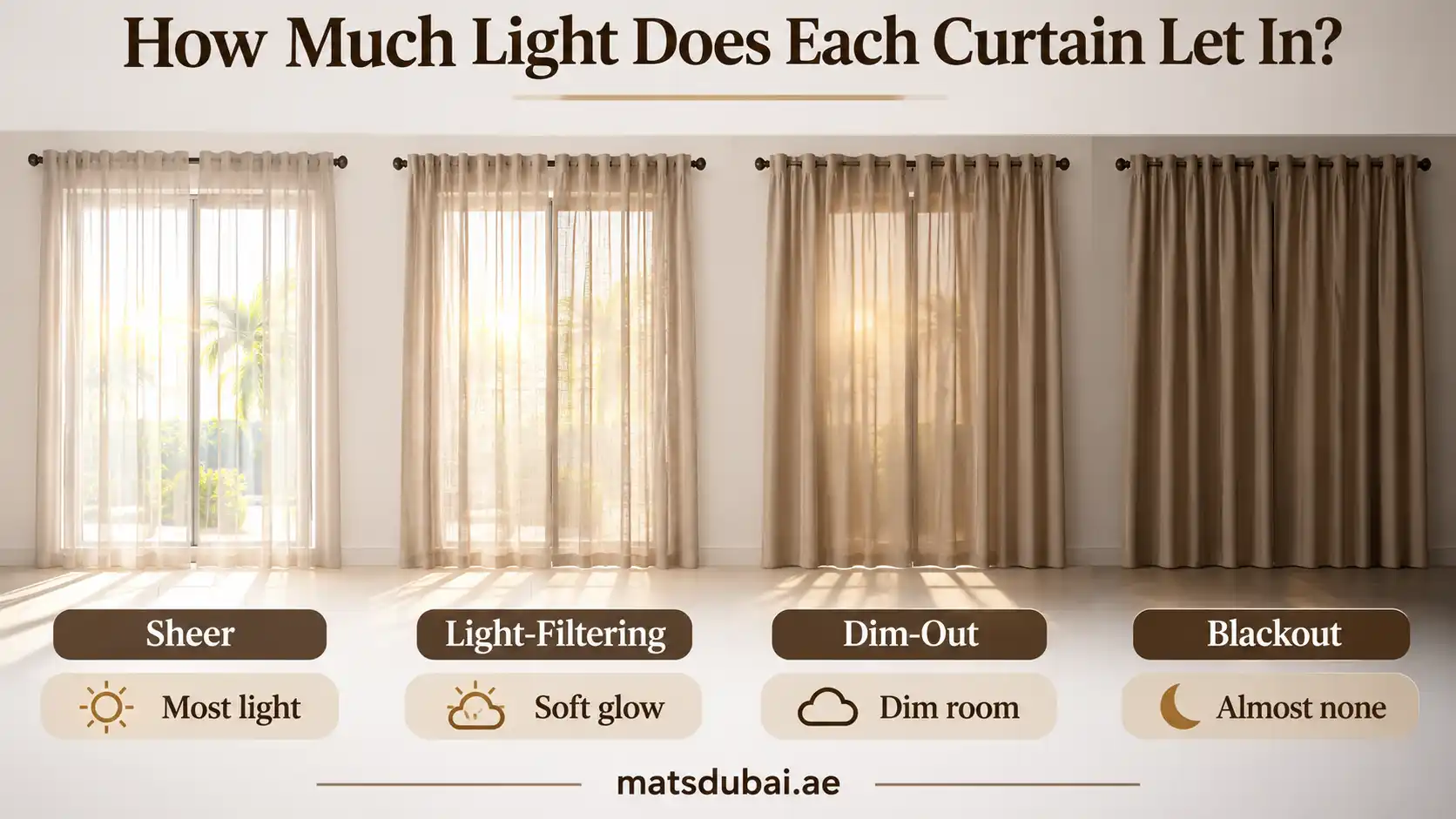
Start here. The job a curtain does matters more than its style. Ask yourself one question first: how much light and privacy do you need in this room?
Curtains sit on a simple scale. Sheer lets the most light in. Blackout lets almost none in. Everything else sits in between.
1. Sheer Curtains

Sheer curtains use thin, see-through fabric such as voile or chiffon. They soften harsh sunlight and give you privacy during the day while keeping the room bright.
Sheers do one thing many people forget. At night, when your lights are on, people outside can see in. So pair sheers with a heavier curtain or blind in bedrooms.
Choose this if: you want a bright, airy living room and daytime privacy from the next tower. See our sheer curtains in Dubai.
2. Light-Filtering and Dim-Out Curtains
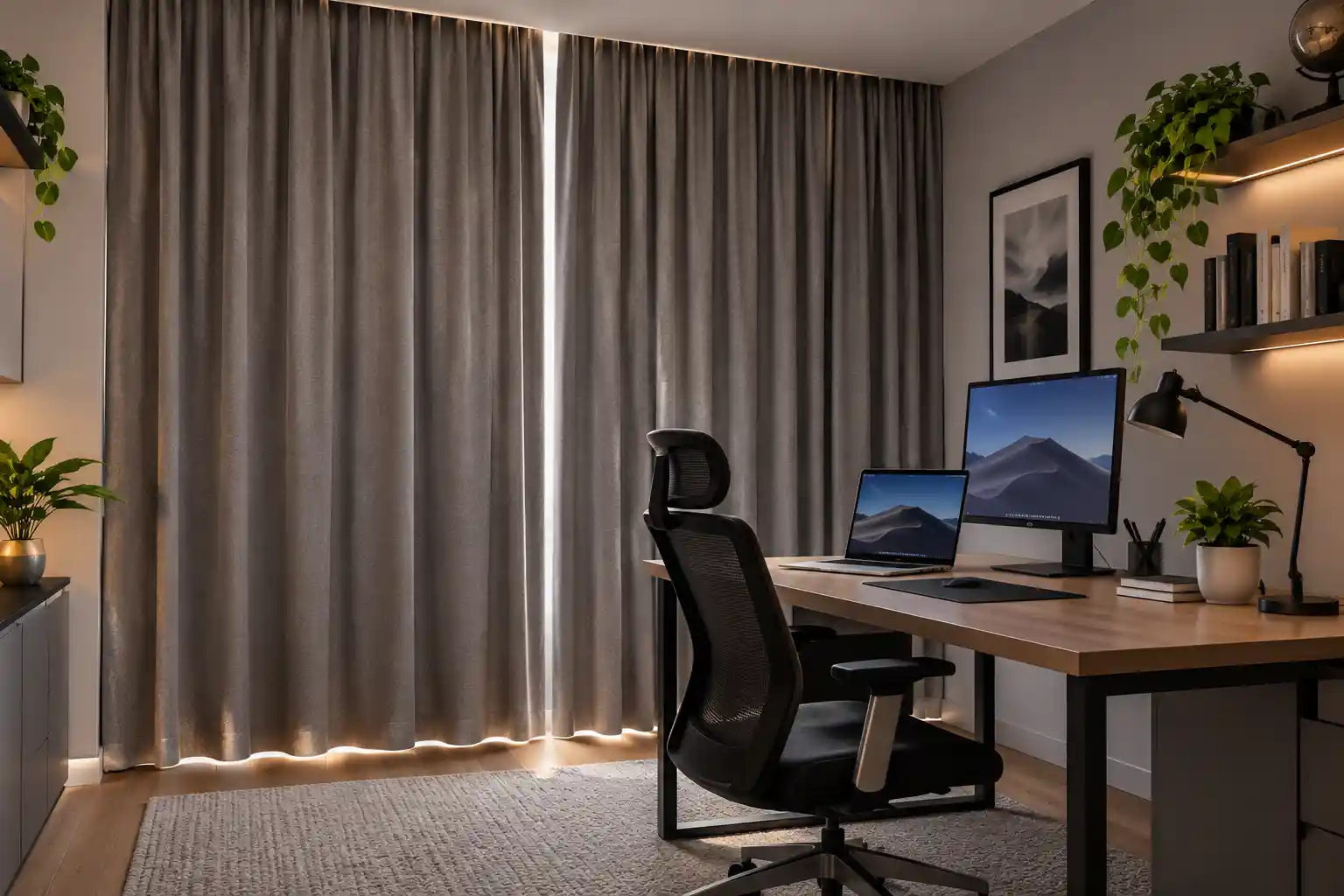
Light-filtering curtains use medium-weight fabric. They turn strong sun into a soft glow and block the view from outside.
Dim-out curtains go one step further. They block most of the light, usually around 80 to 95 percent, but not all of it. The room feels dim and calm, not pitch dark.
Choose this if: you want to cut glare on your TV or laptop but still see without switching on a lamp.
3. Blackout Curtains
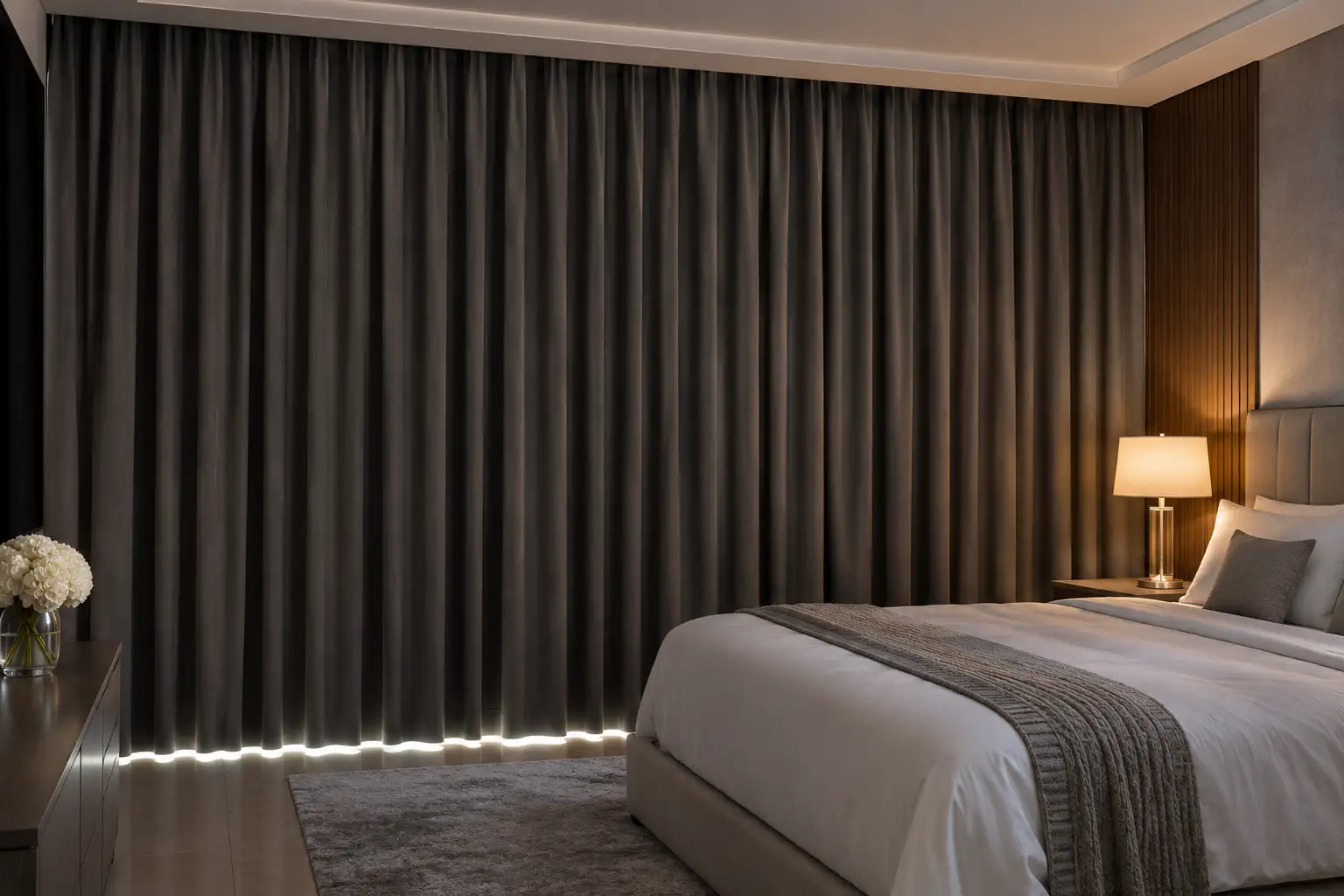
Blackout curtains use tightly woven fabric with a special coating or lining. They block close to 100 percent of light. Some brands and countries call them “blockout” curtains. Both names mean the same thing.
The heavy fabric also keeps out heat and softens outside noise. That makes blackout the top choice for sleep.
Choose this if: the early sunrise wakes you, you work night shifts, or you need a dark nursery or TV room. See our blackout curtains in Dubai.
4. Thermal (Insulated) Curtains
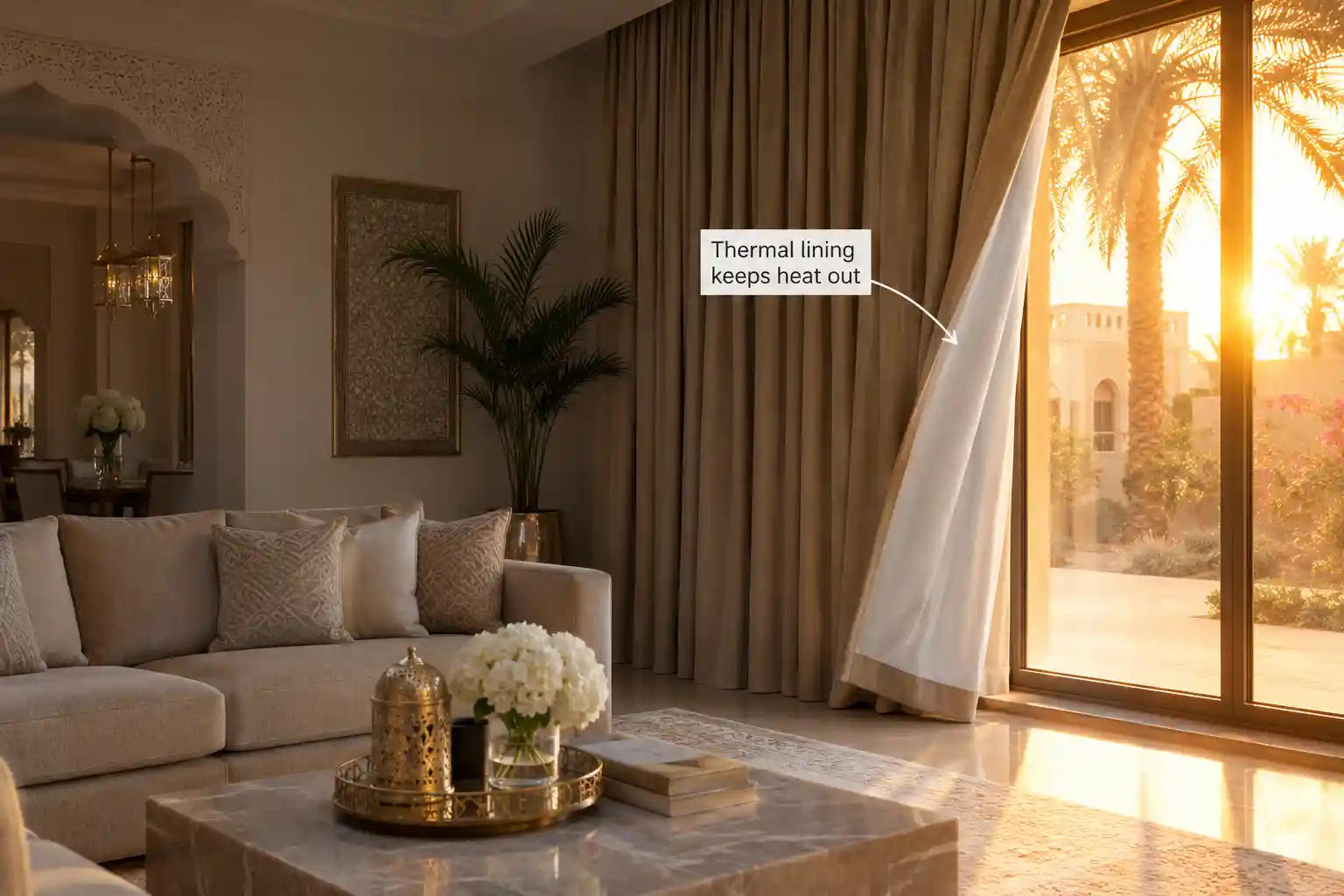
Thermal curtains have an extra insulating layer on the back. This layer slows heat moving through the window.
In the UAE, they keep summer heat out and help your air conditioning work less. Many blackout curtains also have thermal properties, so you often get both benefits in one curtain.
Choose this if: your room faces west or south and gets hot every afternoon.
5. Acoustic (Noise-Reducing) Curtains

Acoustic curtains use thick, dense fabric, often with several layers. The fabric absorbs sound and reduces echo inside the room.
Be realistic. No curtain makes a room soundproof. But a good acoustic curtain clearly softens road and construction noise.
Choose this if: you live near a main road, a construction site, or you need a quieter home office.
6. Day and Night (Double-Layer) Curtains
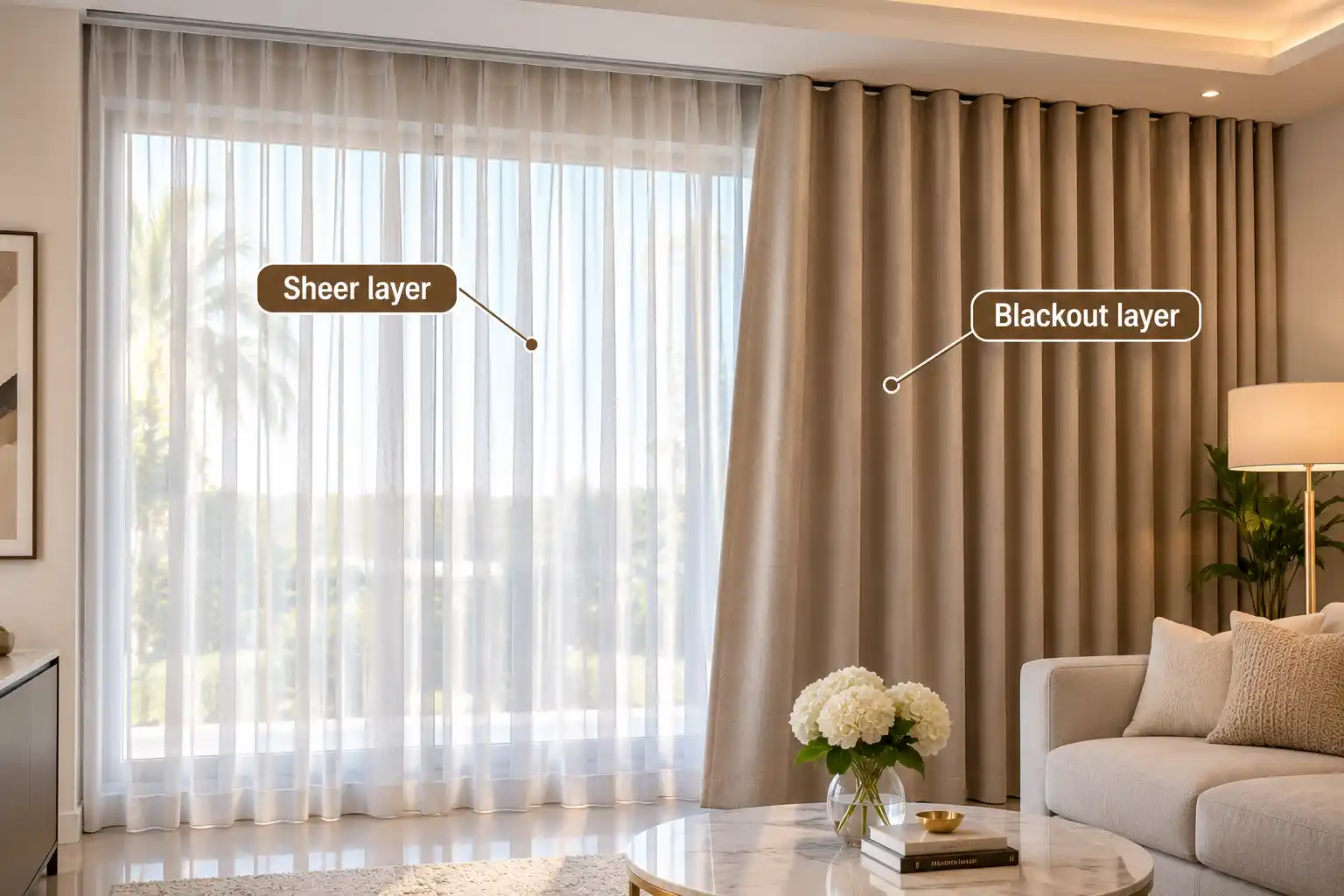
Day and night curtains combine two layers on a double track. A sheer sits at the back for daytime. A blackout or dim-out curtain sits in front for night.
This is one of the most popular setups in Dubai homes. It gives you full control from morning to night.
Choose this if: you want both daylight with privacy and total darkness for sleep in the same room.
7. Fire-Retardant (FR) Curtains
Fire-retardant curtains use fabric treated or woven to resist catching fire and slow the spread of flames.
Offices, hotels, clinics and holiday homes often need FR fabric. Check the exact requirement with your fit-out consultant or building management before you buy.
Choose this if: you are fitting curtains in a commercial space or a rental property.
Types of Curtain Linings
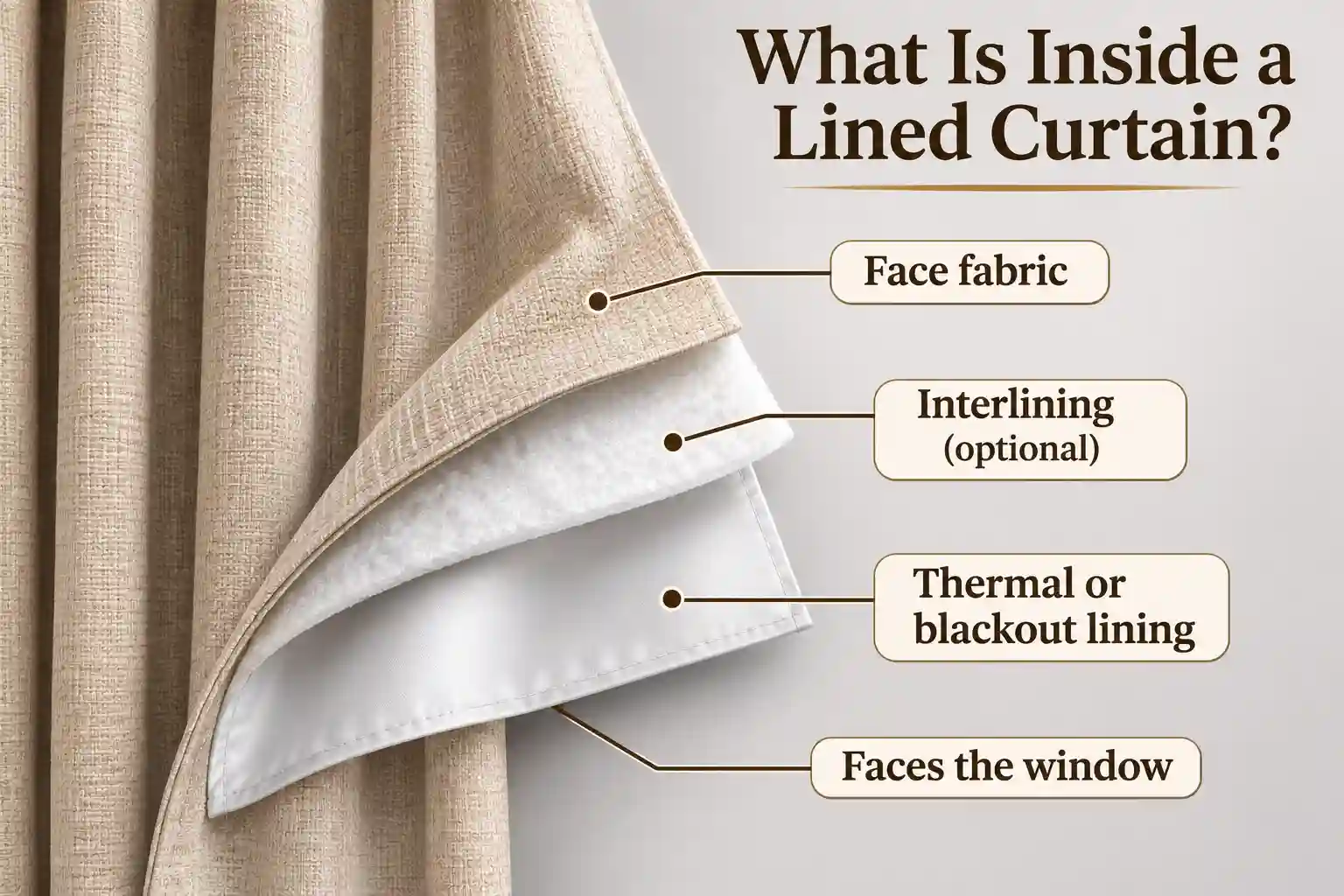
A lining is a second layer of fabric sewn to the back of a curtain. Most people never think about it. Yet the lining often decides how well a curtain blocks light, keeps out heat and lasts in strong sun.
| Lining type | What it does | Best for |
| Unlined | Lets light through; light and breezy | Sheers, kitchens, casual rooms |
| Standard lining | Protects the main fabric from sun, helps it hang well | Living rooms, dining rooms |
| Thermal lining | Adds insulation against heat | West-facing rooms in the UAE |
| Blackout lining | Blocks almost all light | Bedrooms, nurseries, TV rooms |
| Interlining | A soft middle layer for extra fullness and insulation | Luxury drapes in villas and majlis |
Our advice for the UAE: line every main curtain that faces direct sun. The lining takes the UV damage instead of your face fabric, so your curtains keep their colour for years longer.
You can also add a blackout lining to a fabric you love. This way you get the exact colour you want with full darkness behind it.
Types of Curtains by Heading Style
The heading is the top part of the curtain. It decides how the curtain hangs, how the folds look, and how easily it opens and closes.
One term helps here: fullness. Fullness is how much wider the fabric is than the track or rod. A fullness of 2 means 2 metres of fabric for every 1 metre of track. More fullness gives deeper, richer folds. The ratios below are typical; your installer confirms the exact figure for your fabric.
8. Wave (Ripple Fold) Curtains
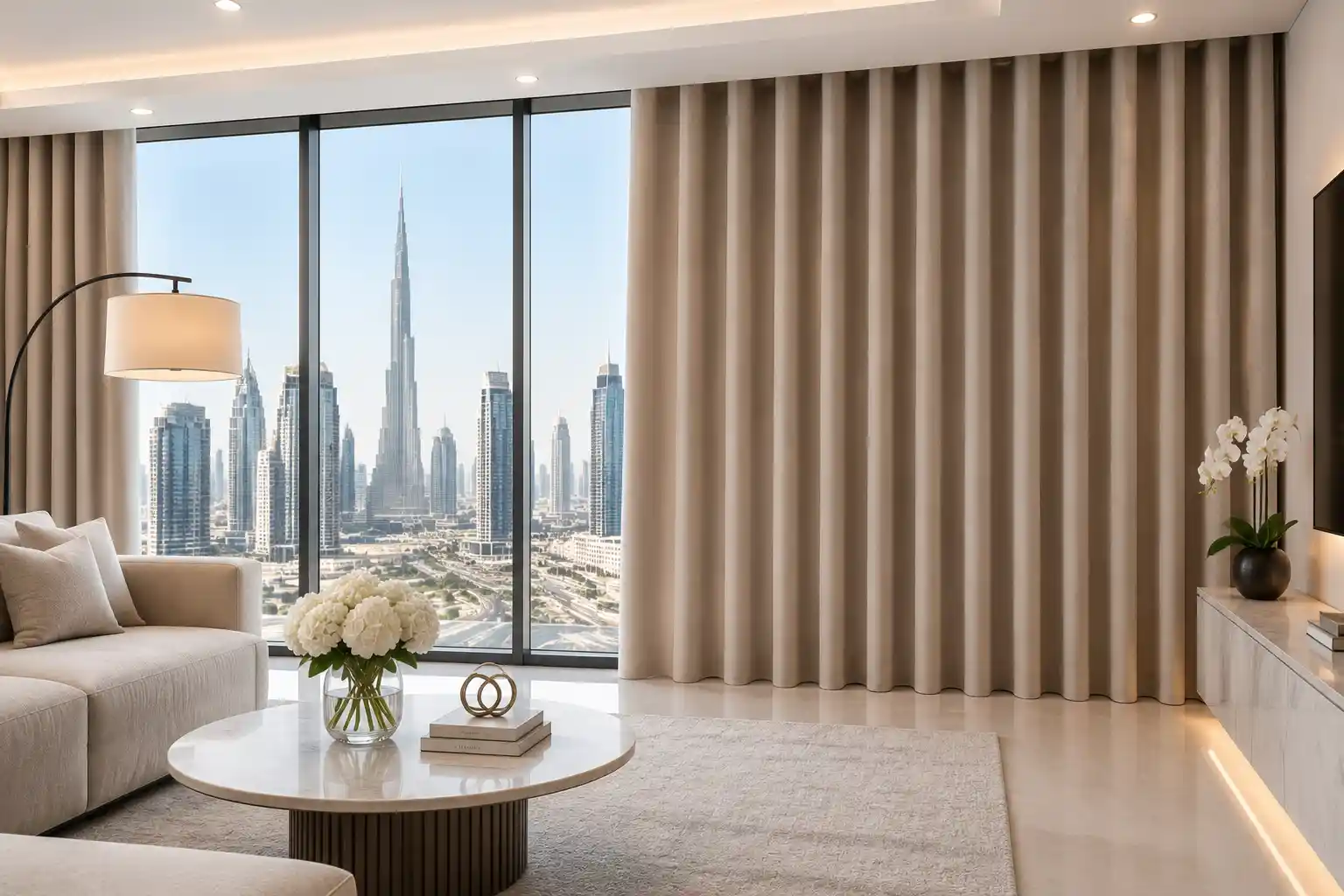
Wave curtains hang from a special track and form smooth, even S-shaped folds from top to bottom. Small carriers on a spaced cord or tape keep every wave the same size.
They glide easily, stack neatly at the side, and suit floor-to-ceiling glass. This is the most requested modern look in Dubai apartments and new villas.
Typical fullness: about 2 to 2.5 times.
Choose this if: you want a clean, modern, hotel-style look on large windows or sliding doors.
9. Pinch Pleat Curtains (Double and Triple)
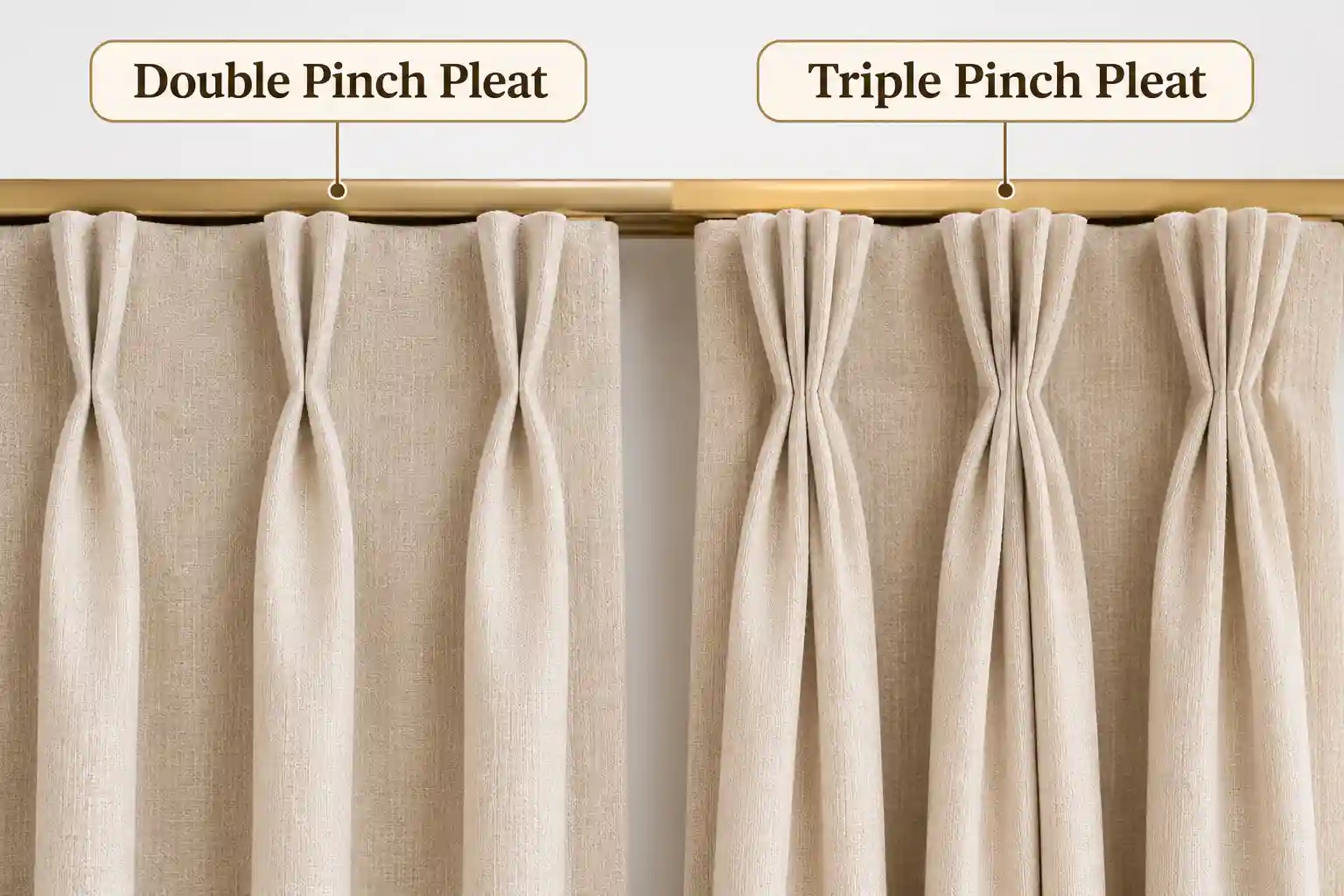
Pinch pleat curtains have groups of folds stitched together at the top. A double pinch pleat has two folds per group. A triple pinch pleat has three, which looks fuller and more formal.
The pleats stay in shape for years and give a tailored, classic finish.
Typical fullness: about 2 to 2.5 times.
Choose this if: you want an elegant living room, master bedroom or majlis.
10. Pencil Pleat Curtains
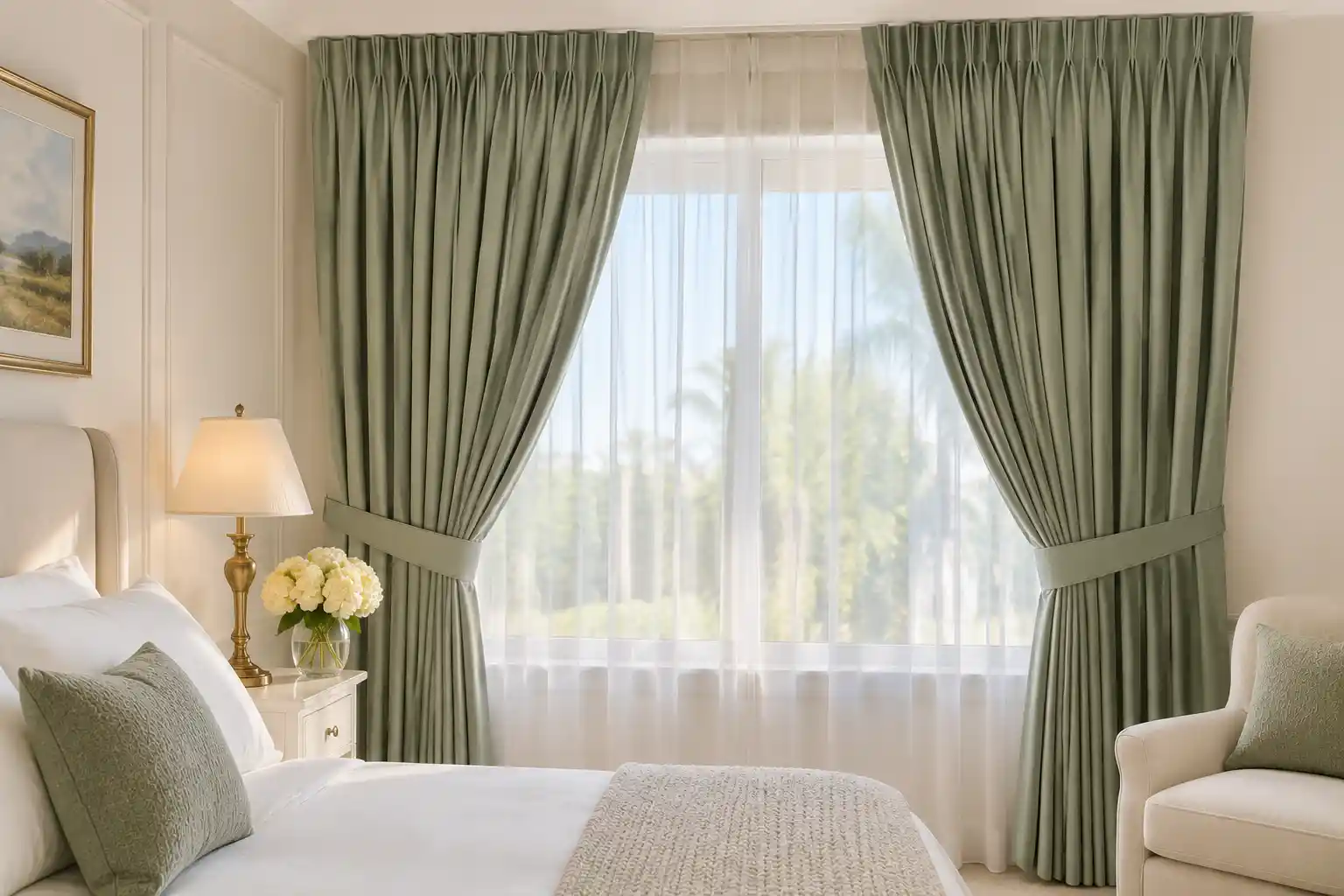
Pencil pleat curtains have tight, narrow folds that look like a row of pencils. A tape with pull cords runs along the top, so you can adjust the gathers by hand.
They work on both rods and tracks and suit most rooms.
Typical fullness: about 2 to 2.5 times.
Choose this if: you want a soft, traditional look that works with many fabrics.
11. Eyelet (Grommet) Curtains
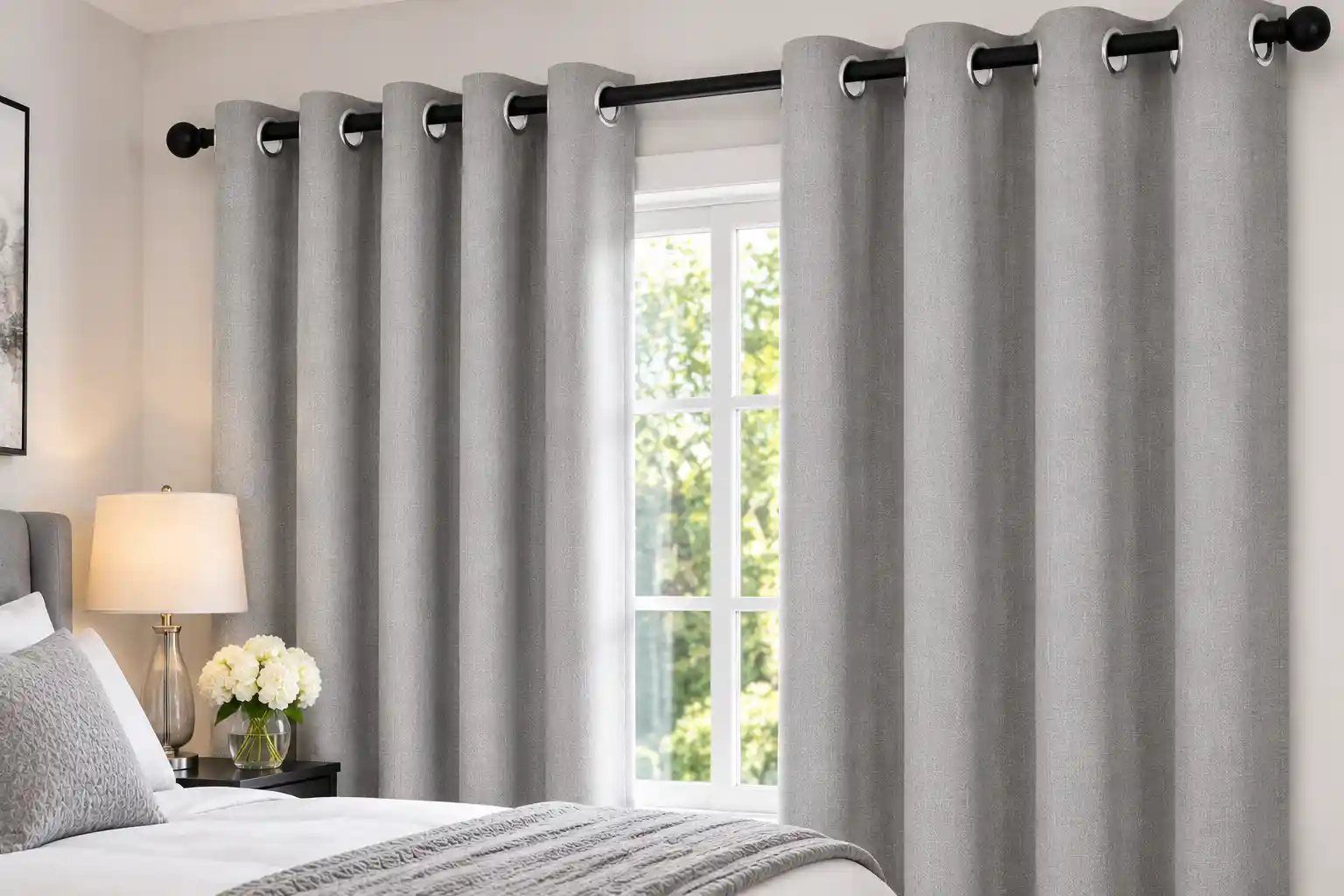
Eyelet curtains have metal or plastic rings punched through the top of the fabric. The rod passes through the rings. “Eyelet” and “grommet” are two names for the same type.
They create wide, even folds and slide very easily, which makes them ideal for curtains you open every day.
Typical fullness: about 1.5 to 2 times.
Choose this if: you want a simple, modern look that is easy to use and easy to take down for washing.
12. Rod Pocket Curtains
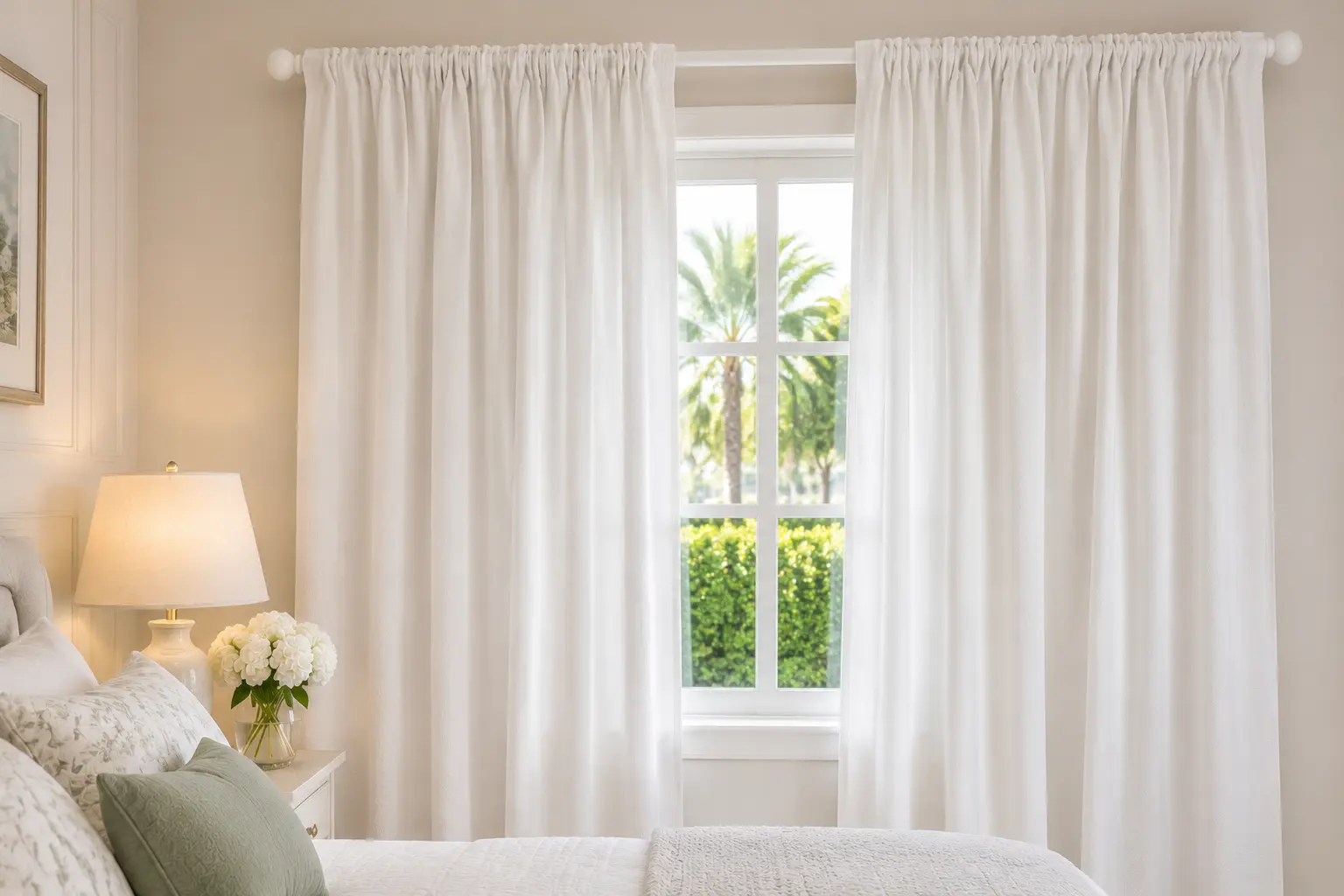
Rod pocket curtains have a sewn tunnel at the top. You slide the rod through this pocket, and the fabric gathers softly along it.
They are hard to open and close often, because the fabric drags on the rod. So they suit curtains that mostly stay in place.
Choose this if: you want a simple, gathered look in a guest room or as a fixed decorative panel.
13. Tab Top Curtains
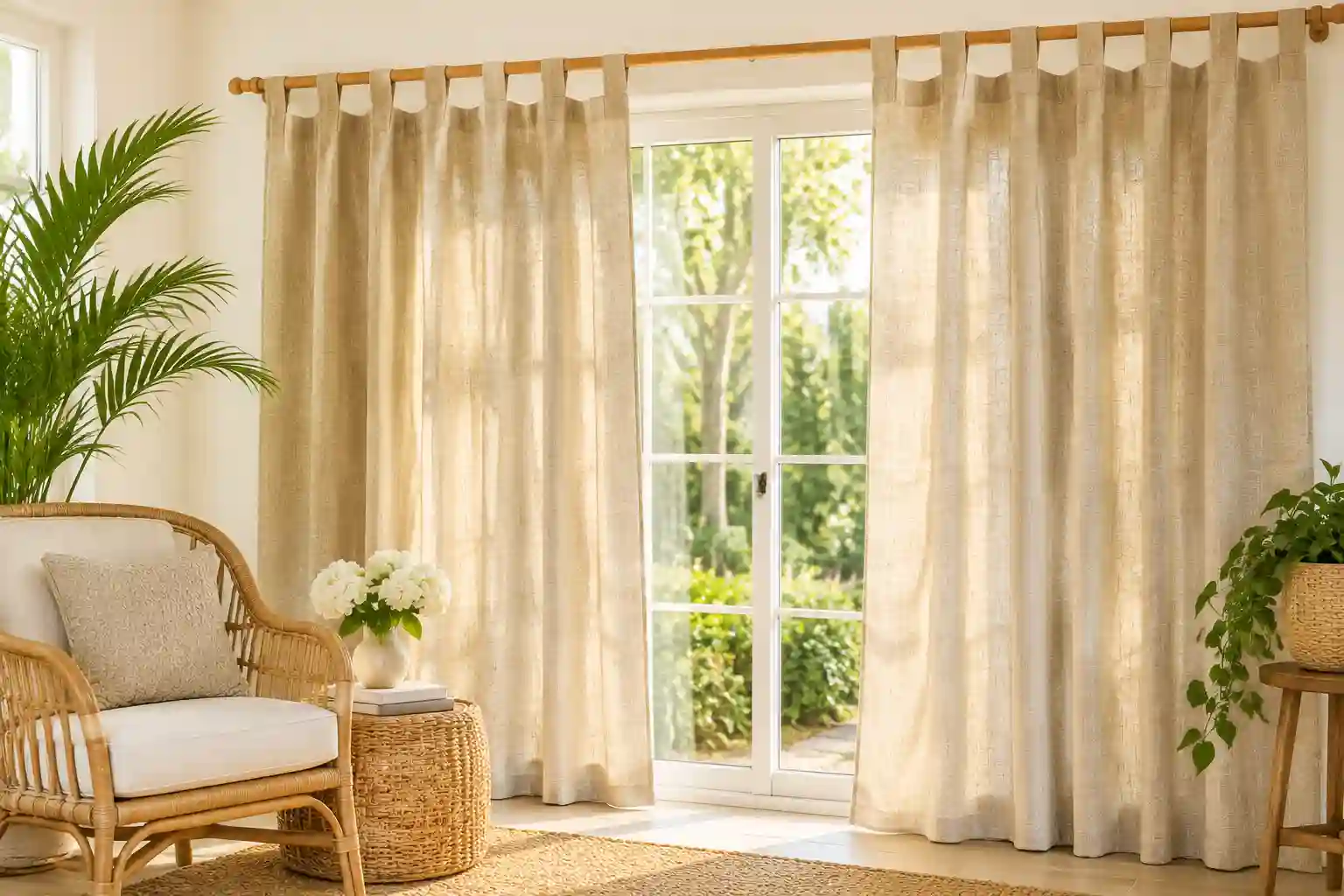
Tab top curtains have fabric loops sewn along the top edge. The rod passes through the loops and stays visible.
They give a relaxed, casual feel that fits farmhouse, coastal or Scandinavian styles.
Choose this if: you want a laid-back look in a sunroom, kitchen or kids room.
14. Tie Top Curtains
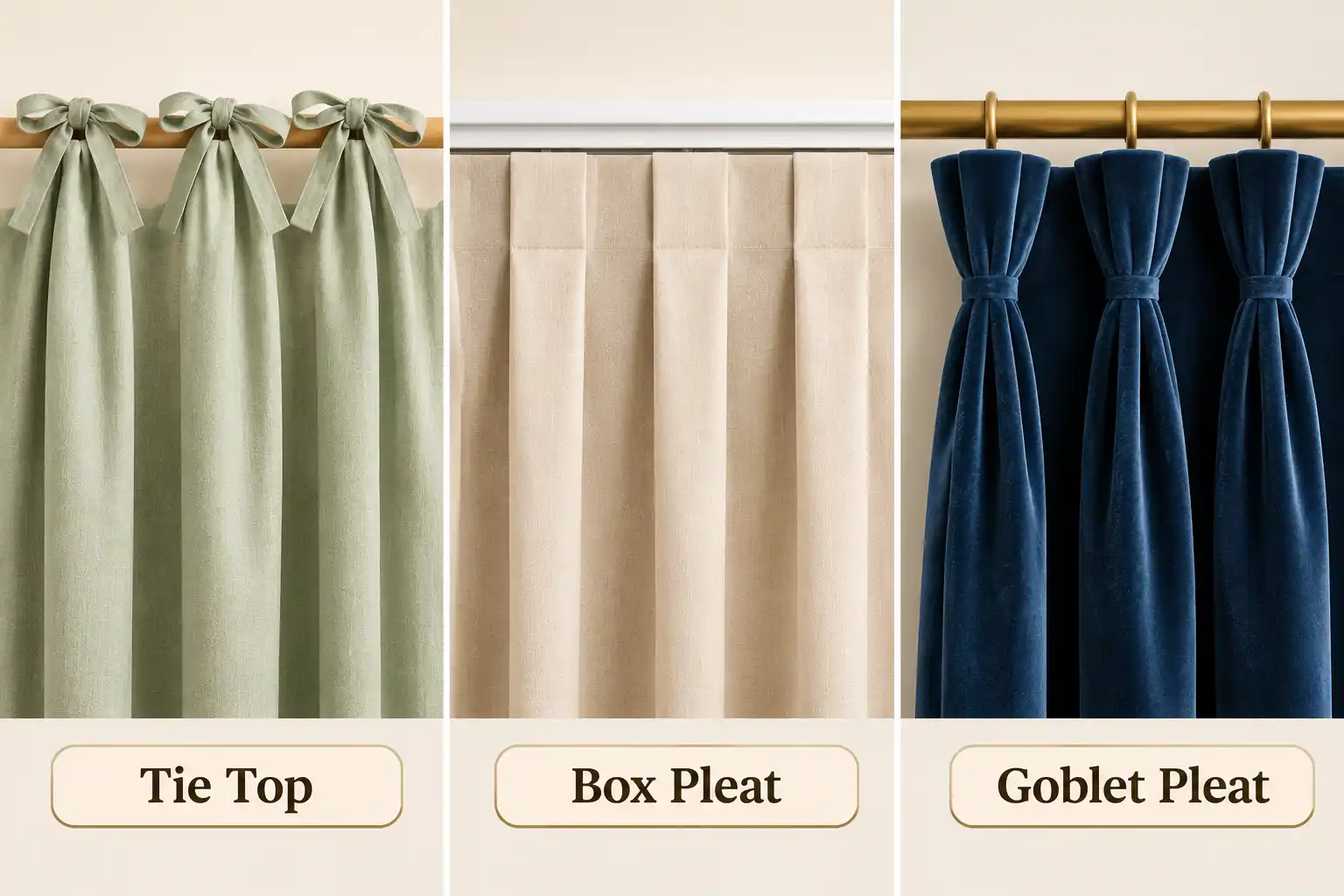
Tie top curtains have fabric ties that you knot around the rod. They look playful and handmade.
They are hard to slide, so use them where you rarely open the curtain.
Choose this if: you want a boho or creative look in a bedroom or nursery.
15. Box Pleat Curtains
Box pleat curtains have deep, flat folds pressed into neat rectangles along the top. The result looks crisp, structured and symmetrical.
Choose this if: you want a tailored look in a dining room, study or office.
16. Goblet Pleat Curtains
Goblet pleats are round, cup-shaped folds at the top, like a wine glass. They often have padding inside to hold their shape.
This is the most formal heading. It suits tall windows and curtains that stay mostly still.
Choose this if: you want a grand, luxurious look in a high-ceiling villa or formal majlis.
Types of Curtain Hooks, Rods and Tracks
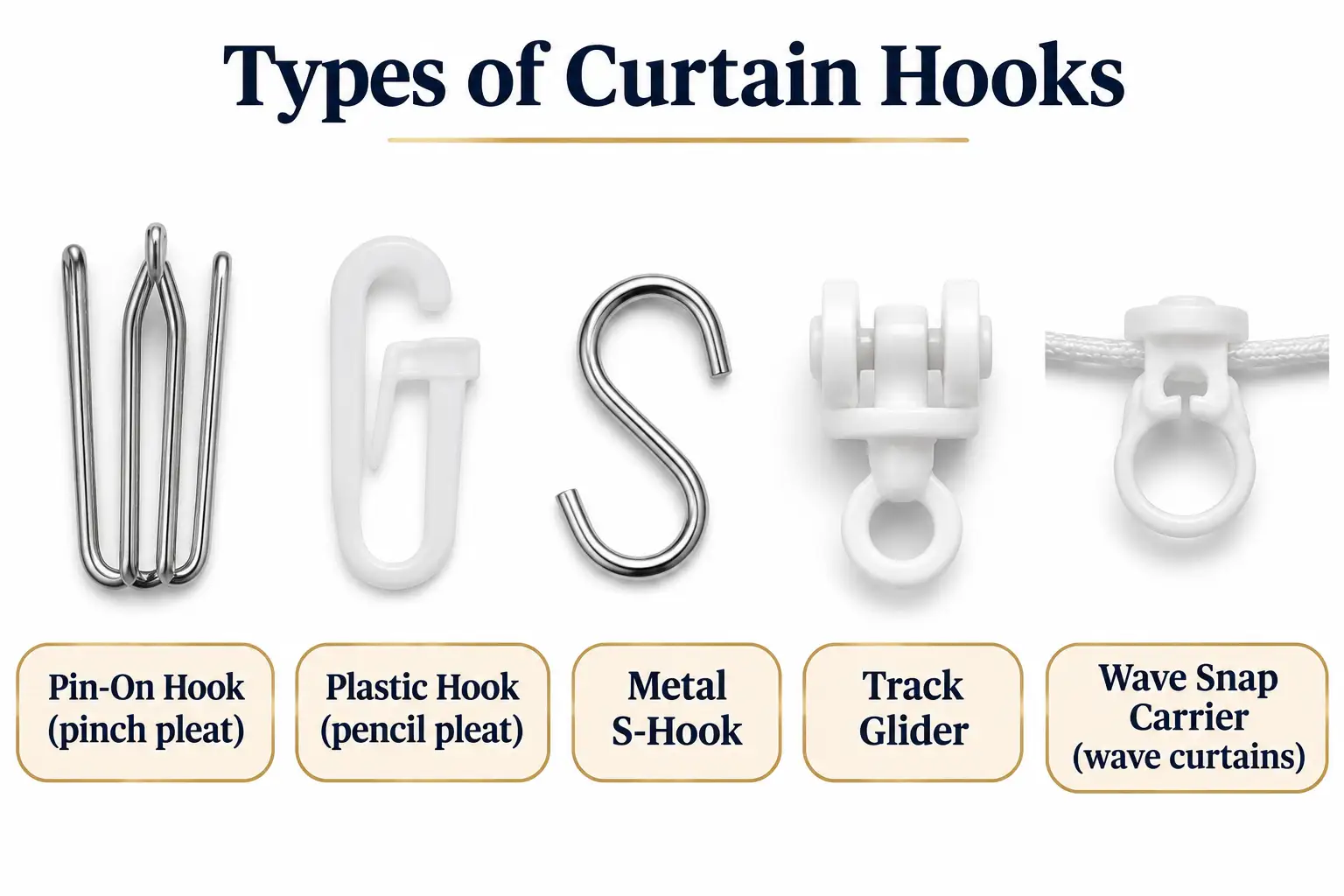
The right curtain on the wrong hardware never hangs well. Each heading style needs a matching hook and a matching rod or track.
Which Curtain Hook Fits Which Heading?
| Heading style | Hook or fitting | Rod or track |
| Wave (ripple fold) | Snap carriers on a spaced cord | Wave track only |
| Pinch pleat | Pin-on or slip-in hooks | Track or rod with rings |
| Pencil pleat | Plastic or metal S-hooks in the heading tape | Track or rod with rings |
| Eyelet (grommet) | None; rings are built into the fabric | Rod only |
| Rod pocket | None; fabric tunnel | Rod only |
| Tab top and tie top | None; fabric loops or ties | Rod only |
| Box and goblet pleat | Pin-on hooks | Track or rod with rings |
Curtain Rod vs Curtain Track
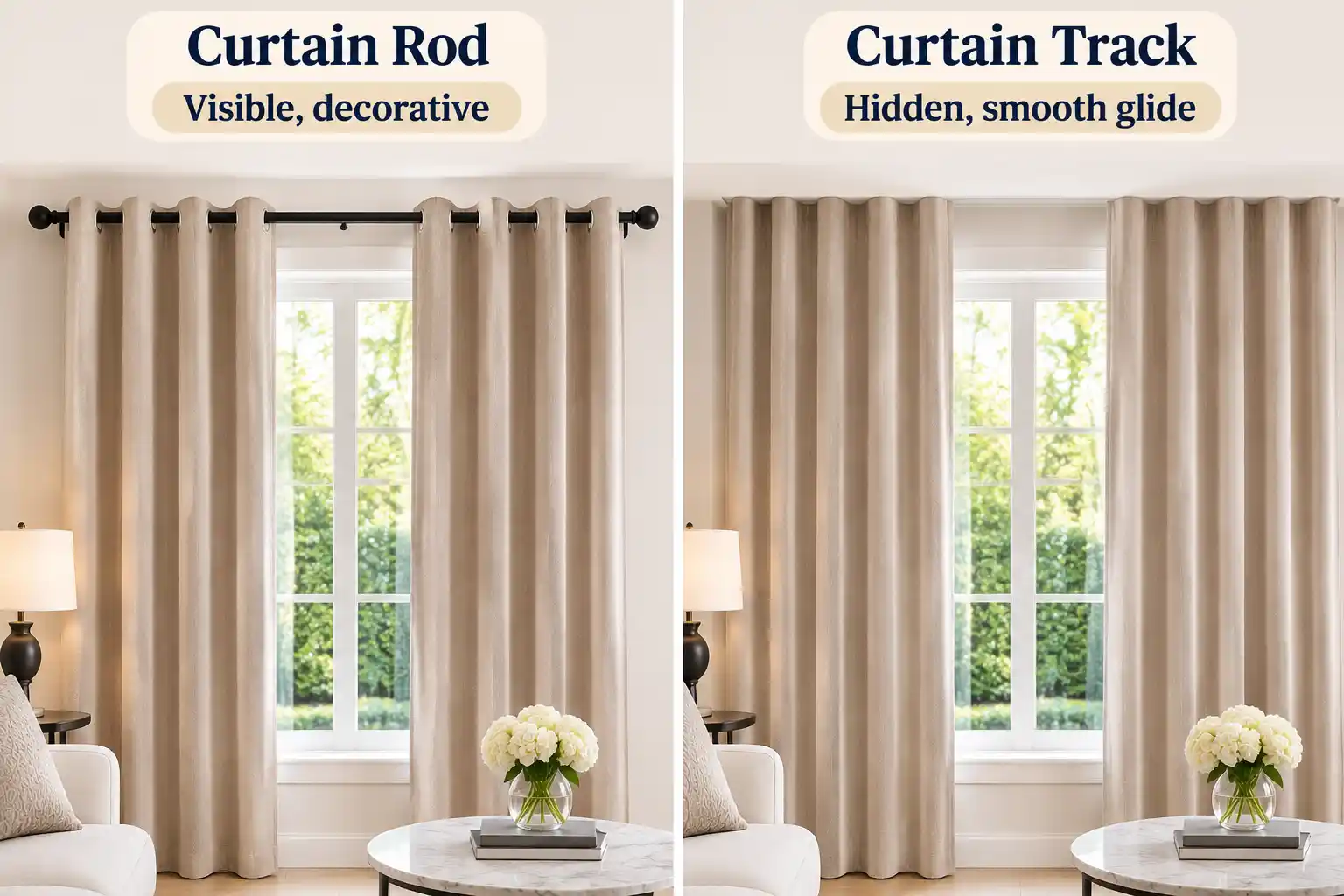
A curtain rod is a pole fixed on brackets above the window. It is a visible, decorative part of the look. Rods suit eyelet, tab top and rod pocket curtains.
A curtain track is a slim rail fixed to the wall or ceiling. Small gliders run inside it. Tracks are almost hidden, curtains move more smoothly, and they can bend around bay or corner windows.
Our recommendation: choose a track for wide windows, heavy fabrics and sliding doors. Choose a rod when you want the hardware to be part of the style.
How to Hang Curtains Without a Rod
You have several good options if you cannot use a rod:
- Ceiling-mounted track: fixes to the ceiling and gives a tall, clean, built-in look. It also stops light leaking over the top.
- Tension rod: springs between two walls inside a window recess. No drilling needed. Best for light sheers and café curtains.
- Wall-mounted track: a low-profile rail that disappears behind the curtain.
- Adhesive hooks or rails: only for very light fabric in small windows.
Renting? Check your tenancy contract or ask your landlord before you drill into walls or ceilings.
17. Motorised Curtains
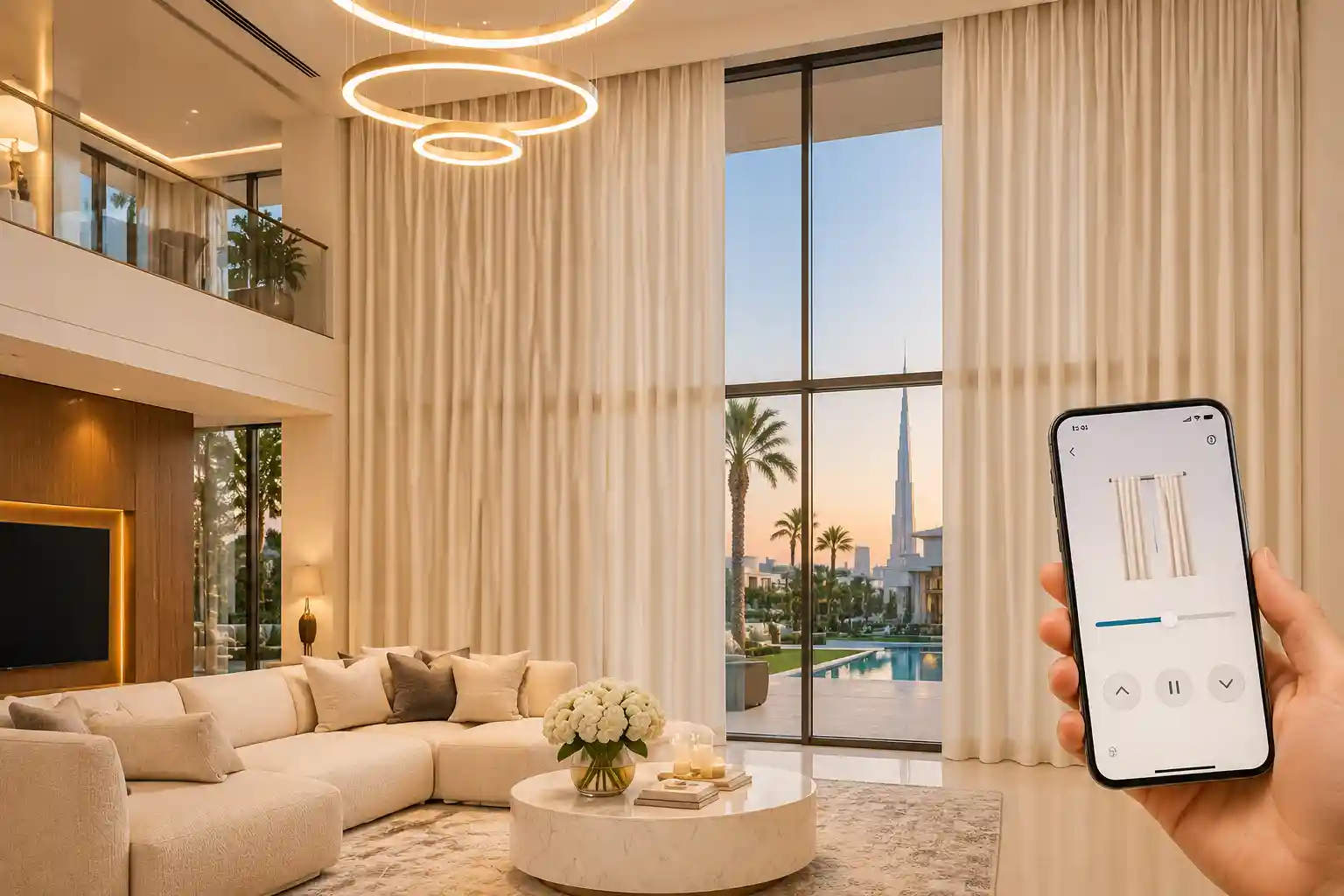
Motorised curtains run on an electric track. You open and close them with a remote, a phone app, a wall switch or a voice assistant. You can also set timers, so curtains close by themselves in the afternoon heat.
They suit double-height villa windows, wide glass walls and curtains that are hard to reach. They are also safer for homes with young children, because there are no loose cords.
Choose this if: you want convenience, a premium feel, or smart-home control. See our motorized curtains in Dubai.
Types of Curtains by Fabric
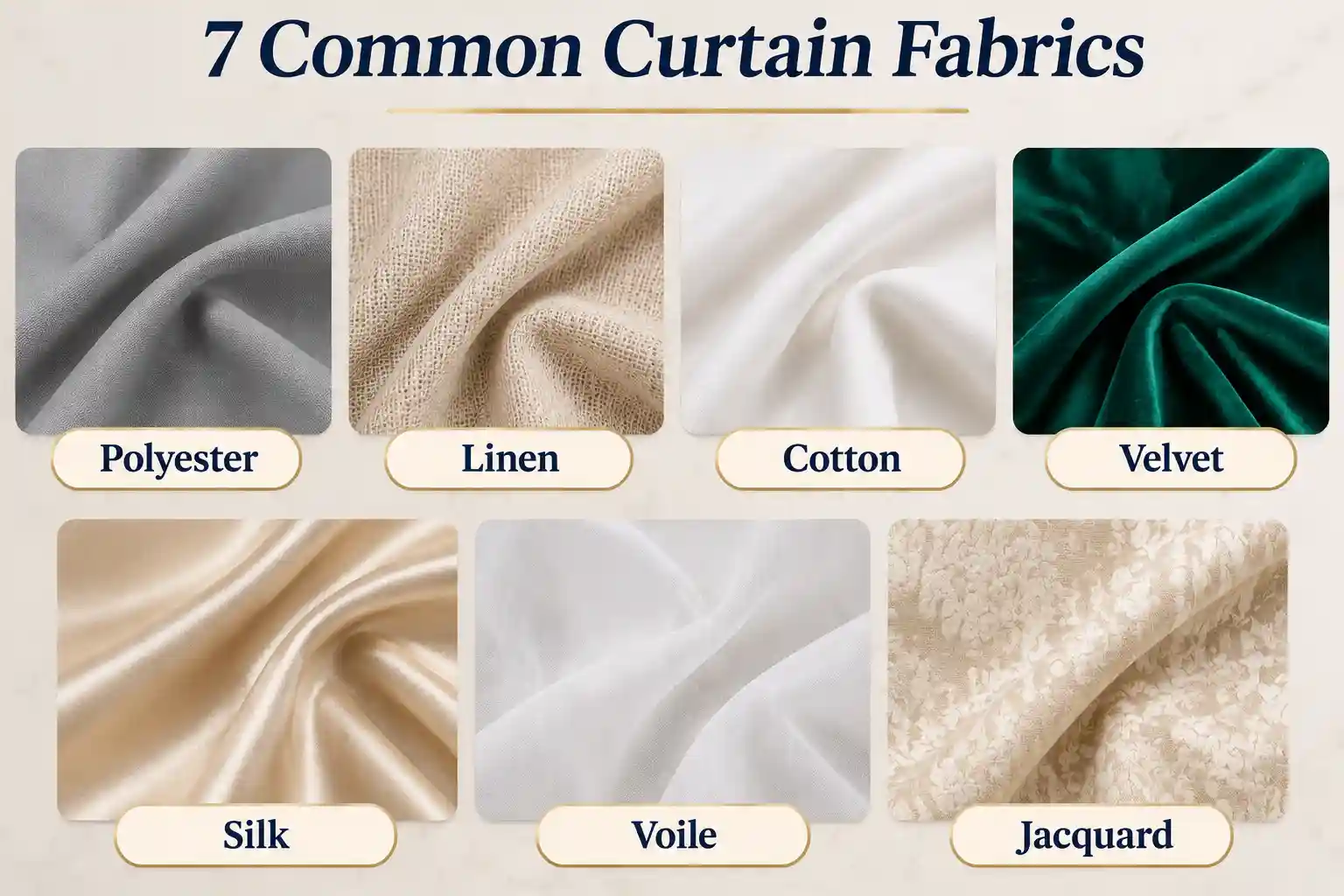
Fabric affects how a curtain looks, how it hangs, how long it lasts in the sun and how easy it is to clean. In the UAE, sun and dust make fabric choice even more important.
| Fabric | Drape | Sun and UV resistance | Care | Price level |
| Polyester | Smooth | High | Machine washable | Low to medium |
| Linen and linen-look | Relaxed, textured | Medium (lining advised) | Gentle wash, creases | Medium to high |
| Cotton | Soft | Low to medium (fades without lining) | Easy wash, may shrink | Low to medium |
| Velvet | Heavy, rich | Medium | Dry clean or vacuum | High |
| Silk and faux silk | Fluid, shiny | Low for real silk | Dry clean | High |
| Voile and chiffon | Very light | Medium | Easy wash | Low |
| Jacquard and damask | Heavy, patterned | Medium to high | Dry clean | Medium to high |
18. Polyester Curtains
Polyester is a strong synthetic fabric. It resists fading, creasing and shrinking, and it is easy to wash.
That makes it the most practical choice for UAE homes. Many “linen-look” and blackout fabrics are actually polyester.
Choose this if: you want durable, low-maintenance curtains on a sensible budget.
19. Linen and Linen-Look Curtains
Linen comes from flax. It has a natural, slightly textured surface and a relaxed, airy feel. Linen-look fabrics copy this style in easier-care polyester blends.
Real linen creases and can fade in strong sun, so add a lining for sunny windows.
Choose this if: you love a calm, natural, Scandinavian or Japandi style.
20. Cotton Curtains
Cotton is soft, breathable and comes in endless colours and prints. It is easy to care for.
Unlined cotton fades fast in direct UAE sun and may shrink in a hot wash. Choose it for shaded rooms or line it.
Choose this if: you want a fresh, printed look in a kids room or family space.
21. Velvet Curtains
Velvet is thick, soft and heavy. It blocks light well, adds warmth and makes a room feel rich and cosy.
Choose this if: you want a luxurious bedroom, home cinema or formal majlis.
22. Silk and Faux Silk Curtains
Silk has a natural sheen and drapes beautifully. Real silk is delicate and can be damaged by strong sun, so it always needs a lining. Faux silk gives a similar shine with better durability.
Choose this if: you want an elegant, formal look in a dining room or master suite.
23. Voile and Chiffon Curtains
Voile and chiffon are the light, see-through fabrics used for most sheer curtains. They let in soft daylight and move gently in a breeze.
Choose this if: you need a sheer layer behind a heavier curtain.
24. Jacquard and Damask Curtains
Jacquard fabrics have patterns woven into the fabric, not printed on top. Damask is a classic type of jacquard with rich, often floral or geometric designs.
They are a popular choice for traditional and Arabic-style interiors.
Choose this if: you want a statement curtain in a majlis or formal living room.
Types of Curtains by Length and Panel
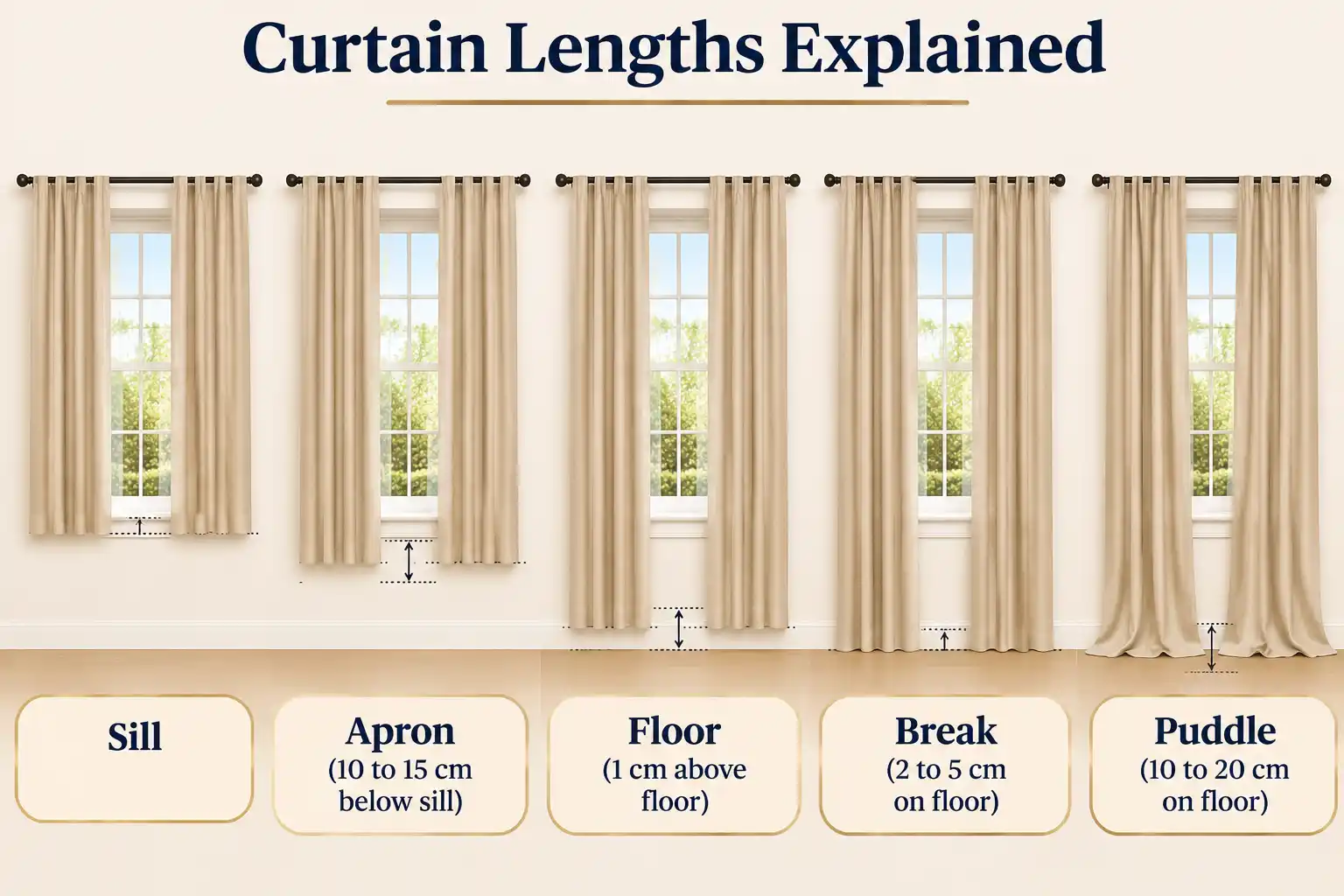
Length changes the whole feel of a room. Longer curtains make ceilings look higher and rooms look grander. Shorter curtains feel casual and practical.
25. Sill-Length Curtains
Sill-length curtains stop just above the window sill. They keep the sill clear for plants or décor and stay away from water and steam.
Choose this if: you are dressing a small kitchen or bathroom window.
26. Apron-Length Curtains
Apron-length curtains fall about 10 to 15 cm below the sill. They look neater than sill length and still stay off the floor.
Choose this if: the window sits above a desk, bed, AC unit or built-in seat.
27. Floor-Length Curtains
Floor-length curtains stop about 1 cm above the floor. This is the most popular length because it looks smart and keeps the hem clean.
A “break” length lets the fabric touch the floor by 2 to 5 cm for a slightly softer look.
Choose this if: you want a polished look in any living room or bedroom.
28. Puddle-Length Curtains
Puddle curtains are extra long. They pool on the floor by about 10 to 20 cm for a romantic, luxurious look.
They collect dust fast, which is a real issue in the UAE. Use them only in low-traffic formal rooms.
Choose this if: you want drama in a formal dining room or master suite.
29. Café Curtains

Café curtains cover only the bottom half of a window. Light comes in from the top while the lower half stays private.
Choose this if: you want privacy at street or garden level in a kitchen, bathroom or ground-floor room.
Single Panel vs Panel Pair
A single panel is one wide curtain that draws to one side. It suits narrow windows, corner windows and doors that open on one side.
A panel pair is two curtains that meet in the middle. It gives a balanced, symmetrical look and suits most standard windows.
Decorative Curtain Add-Ons
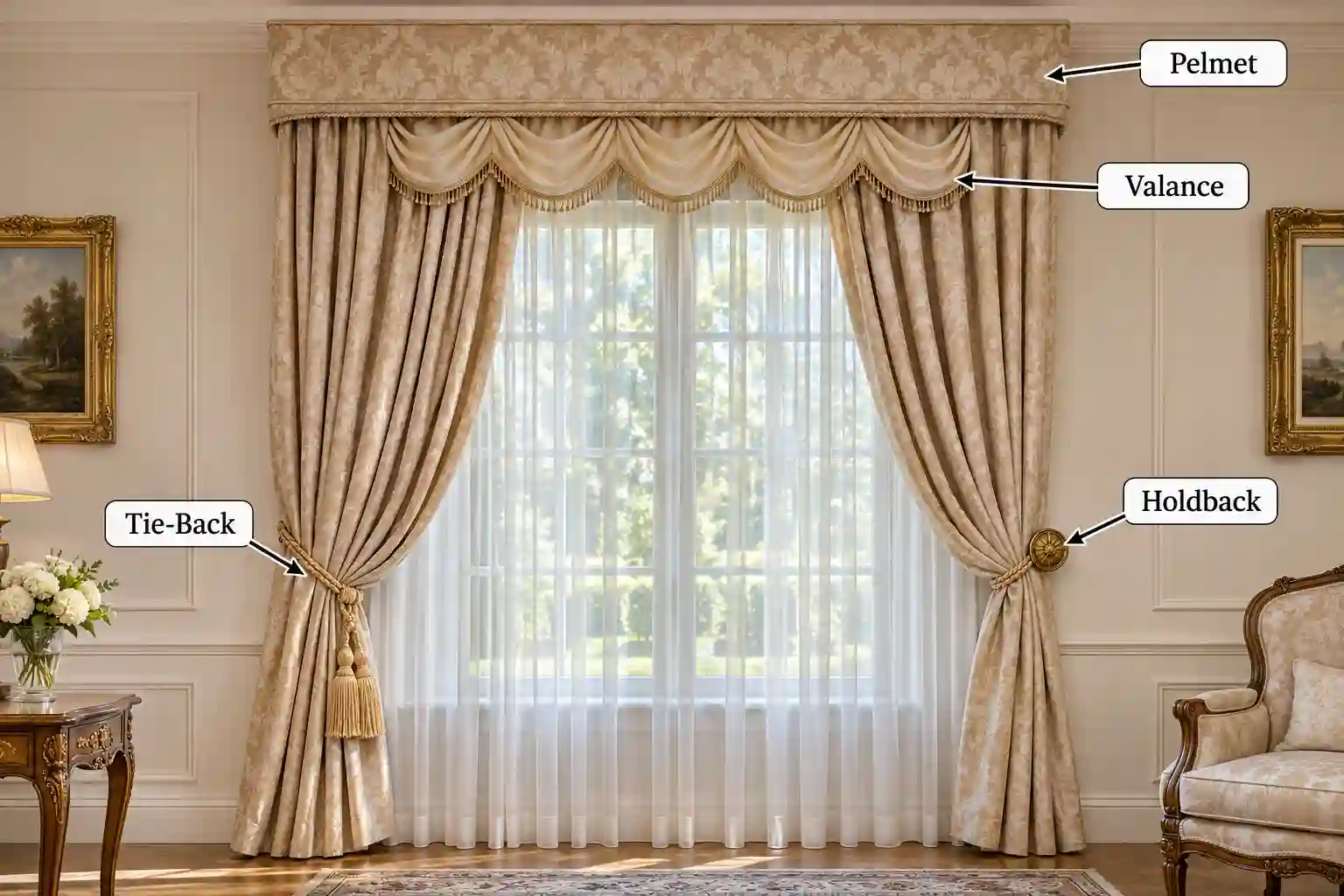
These extras finish the look. Use them with care, because too many can make a modern room feel heavy.
- Valance: a short fabric strip across the top of the window that hides the rod or track.
- Pelmet: a firm, often fabric-covered board across the top. It looks tailored and hides the track.
- Swag: fabric draped in soft curves across the top. It suits classic and traditional rooms.
- Tie-backs and holdbacks: a fabric tie or a fixed wall bracket that holds curtains open. They frame the window and let in more light.
Pelmets and swags remain popular in majlis rooms and formal villa interiors across the UAE.
Types of Curtains for Doors and Special Openings
Not every opening is a standard window. These curtain types solve the tricky spaces found in many UAE homes.
30. Sliding and Balcony Door Curtains
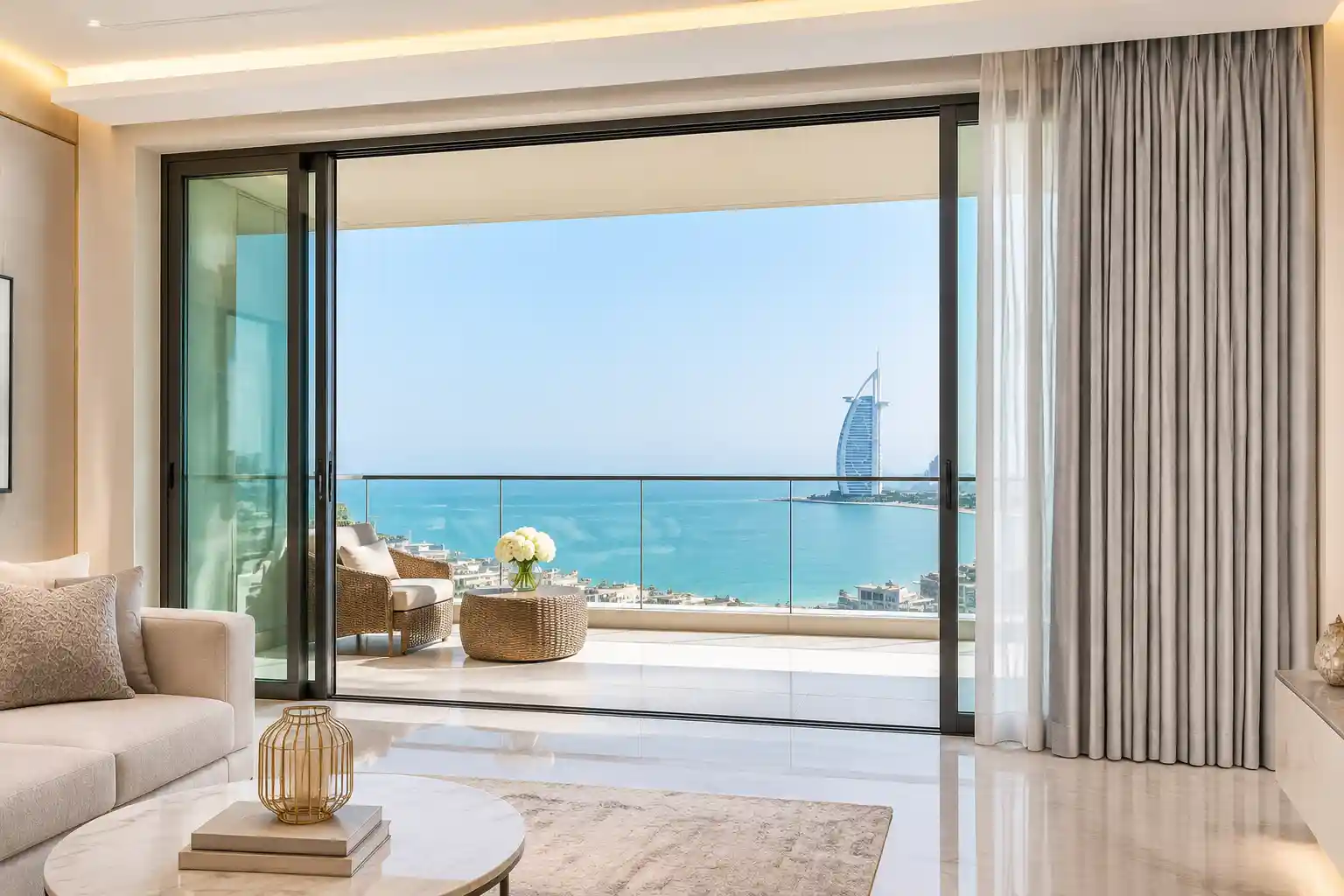
Most Dubai apartments have a glass sliding door to the balcony. Wave curtains on a ceiling track work best here. They glide easily and stack neatly to one side.
Make the track wide enough so the curtain stacks fully clear of the door. That way it never blocks your path or gets caught in the door.
Choose this if: you use your balcony door every day and want a clean look.
31. Front Door and French Door Curtains
Door curtains add privacy to glass front doors and French doors. They also cut glare in entryways. Use a single panel on a rod above the door, or a short panel fixed to the door itself.
Choose this if: your entrance or patio door has glass panels.
32. Room Divider Curtains
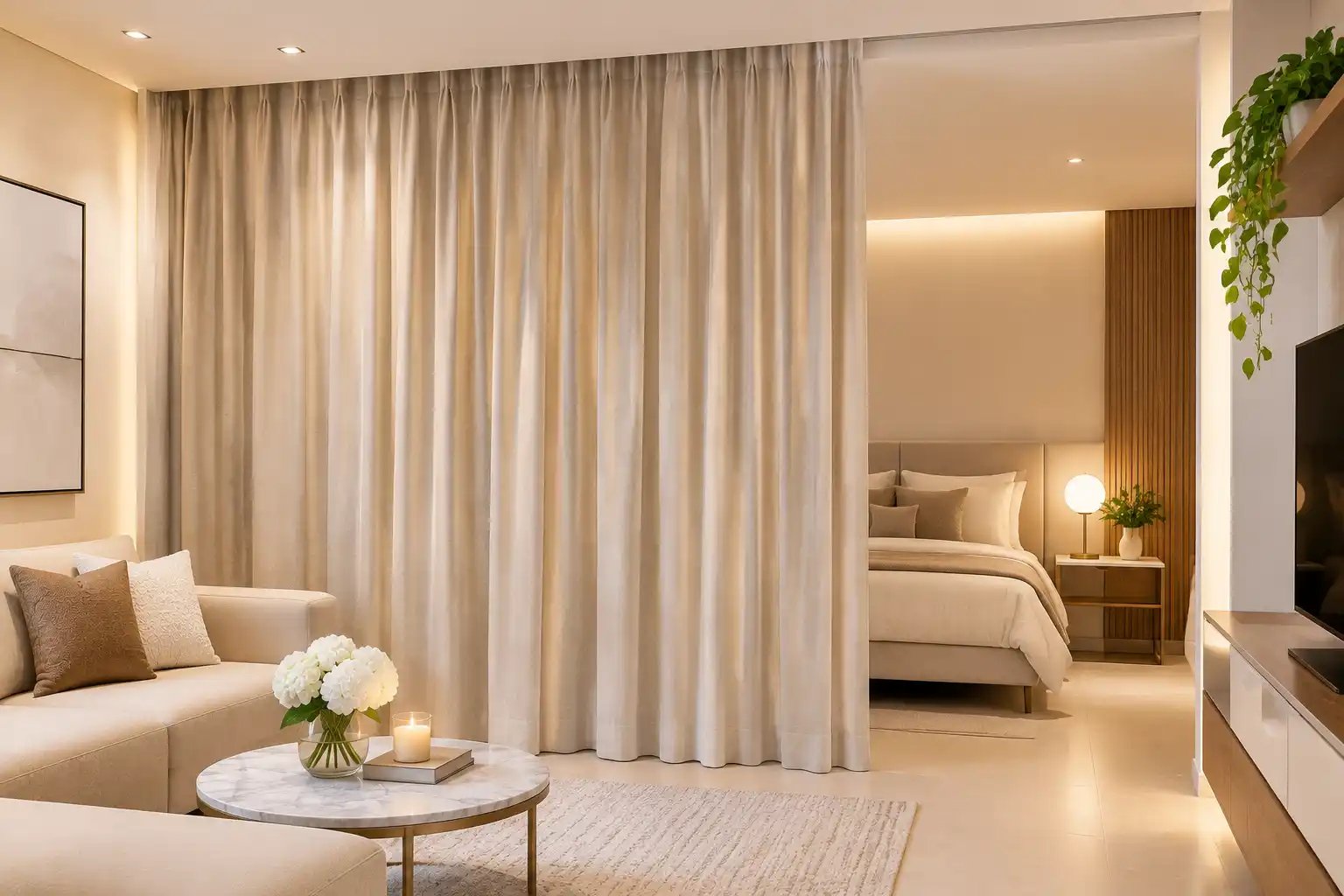
A curtain on a ceiling track can split a large space without building a wall. It can hide a study corner, close off a dressing area, or separate a bedroom in a studio.
Choose this if: you want a flexible space in a studio or an open-plan villa.
33. Bay, Corner and Floor-to-Ceiling Window Curtains
Bay and corner windows need a track that bends to follow the shape. Floor-to-ceiling windows look best with ceiling-mounted wave or pinch pleat curtains that run the full height.
Choose this if: your window is curved, angled, or reaches the ceiling.
34. Outdoor and Pergola Curtains
Outdoor curtains use weather-resistant fabric made to handle sun and humidity. They add shade and privacy to terraces, pergolas and poolside seating.
Choose this if: you want a shaded, private outdoor space during the cooler months.
Best Types of Curtains for Every Room
Here is a simple pick for each room. Each recommendation names the function, the heading and the fabric.
Living Room
Go for day and night curtains: a sheer at the back and a dim-out or blackout curtain in front. Use wave or pinch pleat headings in linen-look polyester.
You get soft daylight, privacy, and full control for TV time in the evening.
Bedroom
Choose blackout curtains with a ceiling-mounted track. Wave or pencil pleat both work well. Add a sheer layer if you want daytime privacy with light.
This setup stops the early summer sun from waking you up.
Majlis
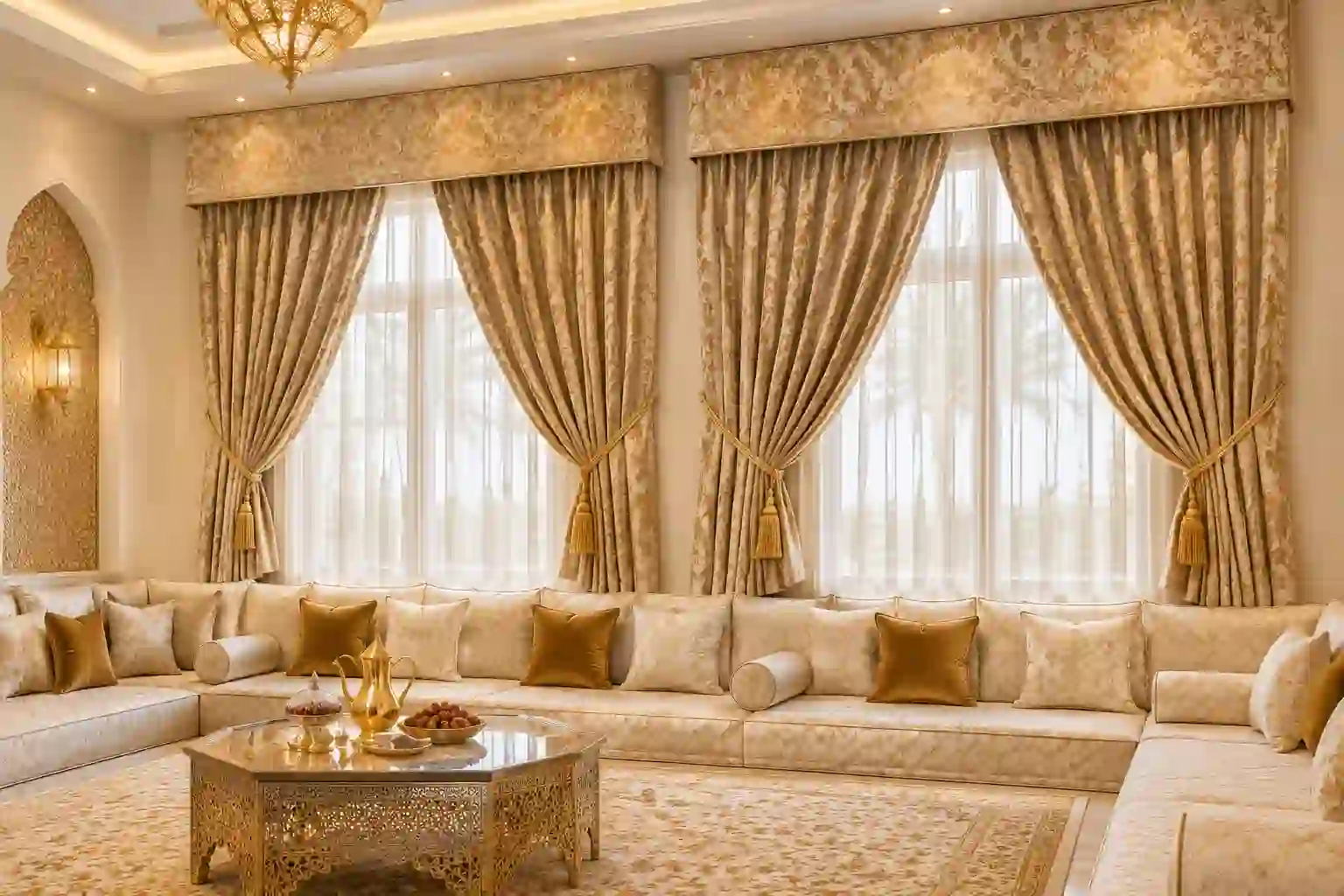
Go for triple pinch pleat or goblet pleat curtains in velvet, jacquard or damask. Add a pelmet or tie-backs for a formal finish. Line every panel to protect the rich fabric from sun.
Kids Room and Nursery
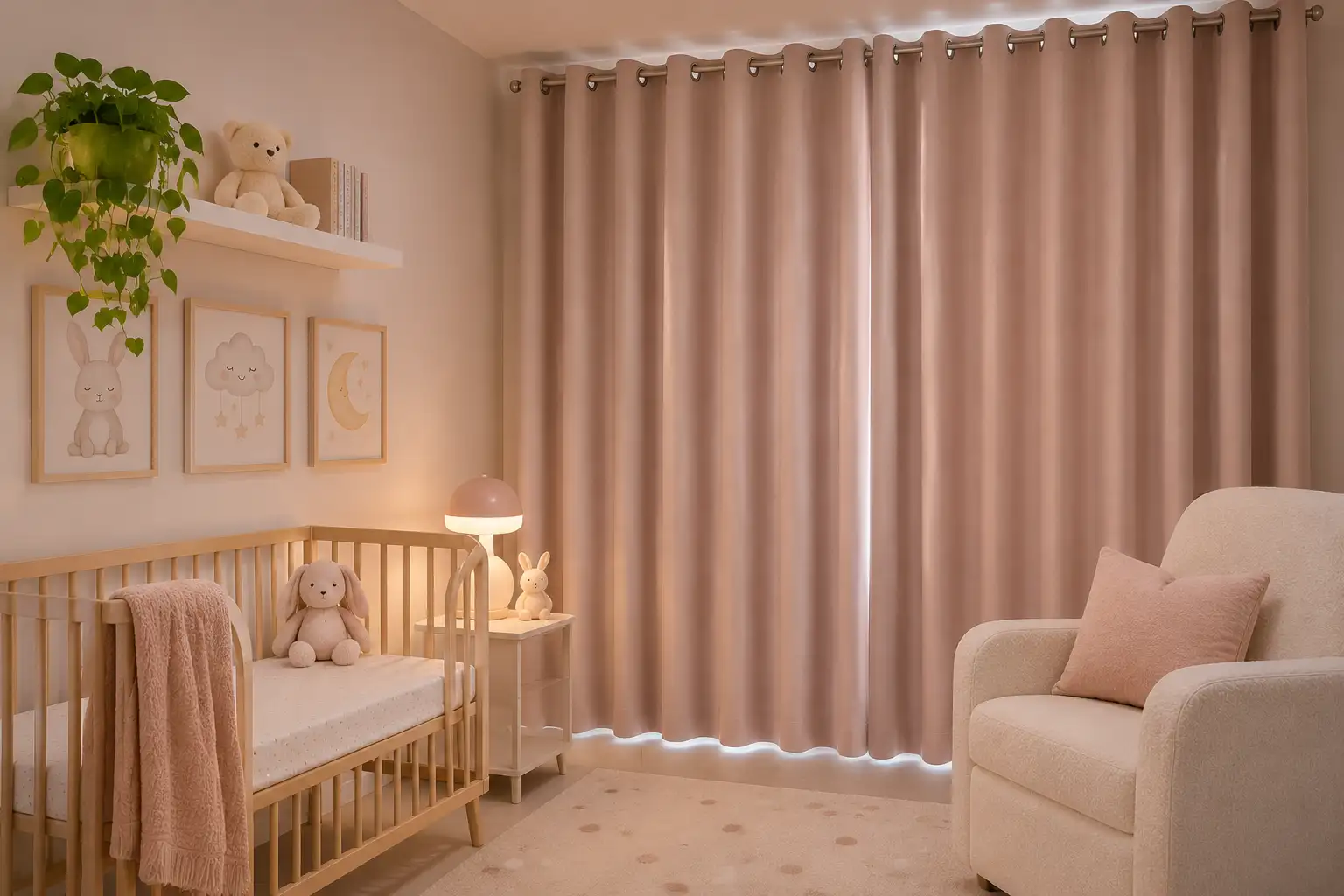
Choose blackout curtains for day naps. Eyelet headings are easy to open and easy to wash. Motorised or cordless options are the safest choice around children.
Kitchen and Bathroom
Use short café or sill-length curtains in washable polyester. Keep fabric away from the stove and water. Many people choose a blind here instead.
Home Office
Pick dim-out curtains to cut screen glare while keeping the room bright enough to work. An acoustic fabric also helps on video calls.
How to Choose Curtains for the UAE Climate
Most curtain guides are written for cool countries. The UAE is different. Strong sun, heat, dust and coastal humidity all affect which curtain type works best.

Block Heat From West-Facing Windows
West-facing rooms take the full afternoon sun. Choose thermal or blackout curtains with a lining. A light-coloured backing that faces the window reflects more heat back outside.
Close these curtains in the afternoon. Your room stays cooler and your AC works less.
Stop UV Fading
UAE sunlight fades fabric, sofas, rugs and wooden floors. Choose UV-resistant polyester and add a lining to every curtain in direct sun. A sheer layer also filters UV before it reaches the main curtain.
Deal With Sand and Dust
Fine dust settles on curtains quickly, especially in villas and near construction. Choose machine-washable fabrics and headings that come off the track easily, such as eyelet or hook-on styles.
Vacuum curtains with a soft brush every month. Wash or professionally clean them every 3 to 6 months.
Handle Coastal Humidity
Homes in Dubai Marina, JBR, Palm Jumeirah and other coastal areas face higher humidity. Synthetic fabrics resist mould and mildew better than natural fibres. Keep curtains slightly away from damp glass and open them daily for airflow.
Stop Early-Morning Light Leaks
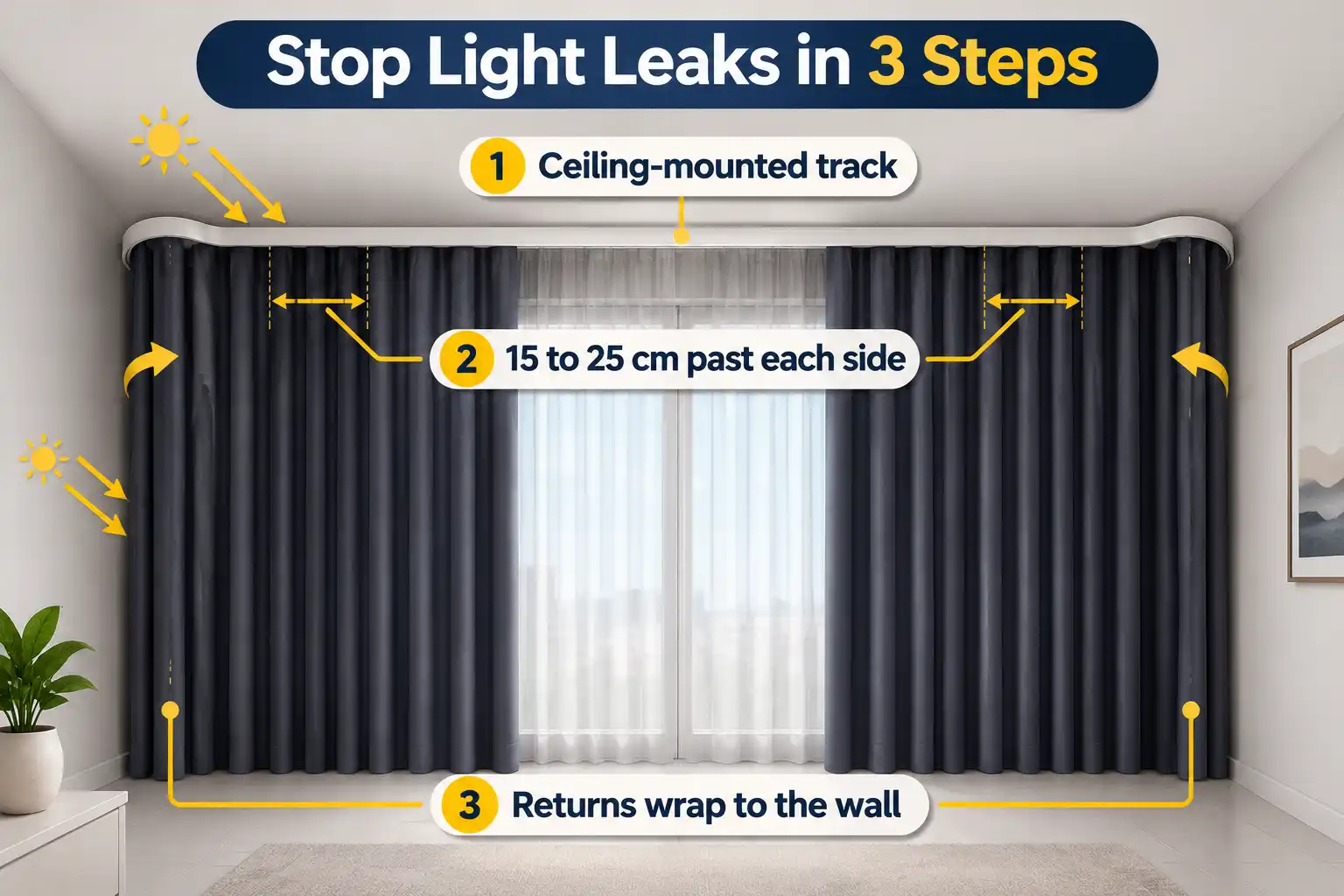
In summer, the sun rises around 5:30 am in Dubai. Even blackout curtains leak light at the top and sides if you fit them wrong.
Fix this with three simple steps:
- Mount the track on the ceiling or close to it.
- Extend the track 15 to 25 cm past each side of the window.
- Ask for “returns”, where the curtain wraps back to the wall at each end.
Expert tip from our installers: For bedrooms exposed to early-morning sunlight, we recommend ceiling-mounted blackout tracks with side returns. This helps minimise gaps around the window, reduces unwanted light entering the room and creates a cleaner, more finished look. The right track positioning is just as important as choosing quality blackout fabric.
Curtains vs Blinds: Which Should You Choose?
Curtains are soft fabric panels that draw sideways. Blinds are fitted coverings that move up and down or tilt. Both control light, but they suit different rooms.
| Feature | Curtains | Blinds |
| Look | Soft, warm, decorative | Clean, neat, minimal |
| Light control | Sheer to full blackout | Precise, often adjustable slats |
| Heat and noise | Better, thanks to thicker fabric and lining | Lower, unless you choose blackout or cellular |
| Space needed | Needs room to stack at the sides | Fits inside the window frame |
| Cleaning | Wash or dry clean | Wipe or dust |
| Best for | Living rooms, bedrooms, majlis, large glass | Kitchens, bathrooms, offices, small windows |
Our recommendation: you do not have to choose only one. A roller blind behind a sheer curtain gives privacy and a soft look. A blackout blind under a decorative curtain gives total darkness with style. Explore our blinds in Dubai and roller blinds.
What Are Roman Curtains?
“Roman curtains” is a common search, but the correct name is Roman blinds. A Roman blind is a flat panel of curtain fabric that folds up into neat, soft pleats when you raise it.
It gives you the fabric look of a curtain with the compact size of a blind. It suits kitchens, kids rooms and windows with little side space. See our Roman blinds in Dubai.
Ready-Made vs Made-to-Measure Curtains
Ready-made curtains come in fixed sizes off the shelf. Made-to-measure curtains are cut and sewn to fit your exact window.
| Feature | Ready-made | Made-to-measure |
| Fit | Standard sizes, often too short or narrow | Exact width, drop and fullness |
| Choice | Limited fabrics and headings | Any fabric, lining and heading |
| Light leaks | Common | Minimal, with correct width and returns |
| Cost | Lower upfront | Higher, but lasts longer |
| Best for | Rentals, small standard windows | Large glass, villas, floor-to-ceiling windows |
Most UAE homes have large or non-standard windows. For these, made-to-measure curtains give a far better fit and look. Ready-made curtains still work well for a quick, low-cost update in a small room.
How to Choose the Right Type of Curtain in 5 Steps
Follow these steps in order. Each step narrows your choice, so you end with one clear answer.
- Decide the function. Do you need darkness for sleep, soft light, privacy, heat control or all of these? This picks your opacity: sheer, dim-out, blackout or a double layer.
- Check the window. Note its size, shape, direction and what sits in front of it. Large glass and sliding doors suit tracks and wave curtains. Small windows suit eyelet, café or a blind.
- Pick the style. Modern rooms suit wave or eyelet. Classic rooms suit pinch pleat or pencil pleat. For colour, a shade slightly darker or lighter than your walls looks calm. A bold colour or pattern works best when the rest of the room is plain.
- Choose the fabric. In sunny rooms, use polyester or a lined fabric. For a natural look, use linen-look. For luxury, use velvet or jacquard.
- Match the hardware. Choose the right hooks and a rod or track for your heading. Decide now if you want motorised control.
5 Common Curtain Mistakes to Avoid
- Hanging curtains too low: fix the rod or track 10 to 15 cm above the frame, or at the ceiling, to make the room look taller.
- Buying curtains too narrow: skimpy curtains look cheap and leak light. Always allow for fullness.
- Skipping the lining: unlined curtains fade quickly in UAE sun.
- Forgetting stack-back space: curtains need room at the sides when open, or they cover part of the glass.
- Choosing sheers alone for bedrooms: they give no privacy at night.
How to Measure for Curtains
Good measuring is the key to a good fit. Use a steel tape and measure in centimetres.
- Width: measure the track or rod length. It should extend 15 to 25 cm past each side of the window. Multiply this by the fullness for your heading to get the fabric width.
- Drop (height): measure from the top of the track or the bottom of the rod rings down to where you want the curtain to end.
- Choose the length: take 1 cm off for floor length, or add 2 to 5 cm for a break.
- Check obstacles: note sockets, AC units, handles and door swings.
Not sure about your numbers? Our team offers a free site visit to measure and advise. See our curtain fixing service.
How Much Do Curtains Cost in Dubai?
Curtain prices in Dubai depend on a few clear factors:
- Fabric: polyester costs less than linen, velvet or silk.
- Lining: blackout and thermal linings add to the price.
- Heading: wave and triple pinch pleat need more fabric than eyelet.
- Hardware: a ceiling track or a bent bay track costs more than a simple rod.
- Motorisation: a motor and smart control add a one-time cost.
- Size and number of windows: large glass walls and double-height windows need more fabric and labour.
Curtain prices at Mats Dubai start from AED 45 per sqm for sheer curtains and vary by fabric and style, with options such as blackout, linen, velvet and motorised curtains available at different price ranges.
The best way to know your exact cost is a free, no-obligation quote. Book a site visit and we will measure every window and show you fabric samples at home.
Final Thoughts: Which Type of Curtain Should You Choose?
The best curtain starts with the job you need it to do. Use this quick guide to decide:
- For better sleep: blackout curtains on a ceiling track.
- For daytime privacy with light: sheer curtains.
- For full control all day: day and night double-layer curtains.
- For heat control: thermal or lined blackout curtains.
- For a modern look: wave curtains.
- For a classic or formal look: pinch pleat curtains.
- For convenience and high windows: motorised curtains.
In the UAE, always line curtains that face the sun, pick fabrics you can wash, and fit them wide and high enough to stop light leaks.
Ready to choose your curtains? Mats Dubai offers a free site visit, expert advice and professional fitting across Dubai and Abu Dhabi. We bring fabric samples to your home, measure every window and fit everything for you. Explore our curtains in Dubai and curtains in Abu Dhabi, or call / WhatsApp us on +971 50 293 3585 to book today.
Frequently Asked Questions
What are the main types of curtains?
The main types are grouped by function (sheer, dim-out, blackout, thermal, acoustic), by heading style (wave, pinch pleat, pencil pleat, eyelet, rod pocket, tab top), by fabric (polyester, linen, cotton, velvet, silk) and by length (sill, apron, floor and puddle).
What is the most popular type of curtain in Dubai?
In our experience, wave curtains and pinch pleat curtains are the most requested. Most homeowners fit them as day and night curtains, with a sheer layer and a blackout layer on a double track.
What is the difference between curtains and drapes?
Curtains are usually lighter and often unlined. Drapes (or draperies) are heavier, lined and usually floor-length for a formal look. Many people now use both words for the same thing.
Which curtains are best for blocking heat in the UAE?
Thermal or blackout curtains with a lining block the most heat. Choose a light-coloured backing facing the window and fit them on a ceiling track with returns.
What is the difference between blackout and dim-out curtains?
Blackout curtains block close to 100 percent of light. Dim-out curtains block most light, usually around 80 to 95 percent, so the room feels dim but not fully dark.
What type of curtain hooks do I need?
It depends on the heading. Pinch pleat and goblet pleat use pin-on hooks. Pencil pleat uses plastic or metal hooks in the tape. Wave curtains use snap carriers. Eyelet, rod pocket and tab top curtains need no hooks.
Can I hang curtains without a rod?
Yes. You can use a ceiling-mounted track, a wall-mounted track, a tension rod inside the window recess, or adhesive hooks for very light sheers.
Which curtains are best for sliding doors?
Wave curtains on a ceiling track work best. They glide easily, stack neatly and stay clear of the door when open.
Are wave curtains better than pinch pleat curtains?
Neither is better; they suit different styles. Wave curtains look modern and minimal. Pinch pleat curtains look classic and formal. Choose the one that matches your interior.
How often should I clean curtains in Dubai?
Vacuum them with a soft brush about once a month. Wash or professionally clean them every 3 to 6 months, or more often in dusty areas.