

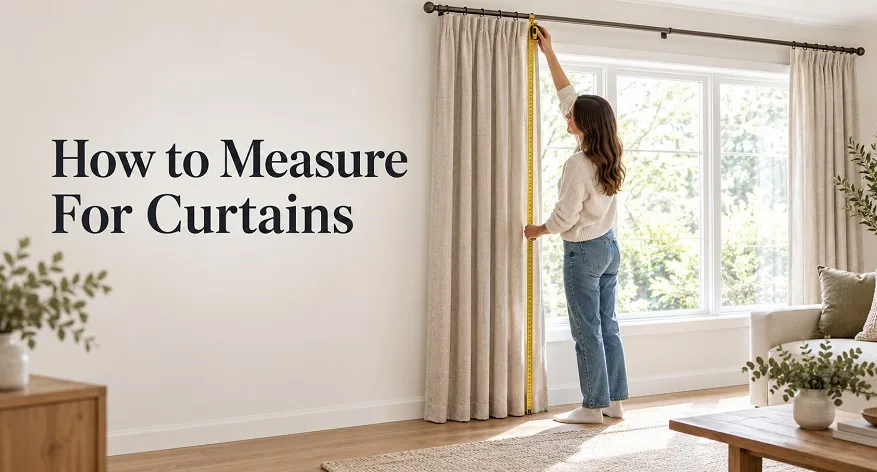
New curtains can change the whole feel of a room. But if you get the size wrong, they look short or thin, or they let light pour in at the sides.
The good news is that learning how to measure for curtains takes about 10 minutes. You only need two numbers: the width and the drop.
In this curtain measuring guide, you will learn exactly where to put your tape, how much extra to add, and how to turn your numbers into the right curtain size. We cover every common header type, standard curtain sizes in cm and inches, and tricky windows like bays. There is also a free calculator that does the maths for you.
To measure for window curtains, measure the width of your curtain pole or track without the decorative ends (finials). Then measure the drop from the right starting point for your curtain header down to where you want the curtains to end. Measure the drop in three places and use the shortest number.
Two words you need to know
- Width: how wide your curtains need to be, from side to side.
- Drop: how long your curtains need to be, from top to bottom. In the US this is usually called the length.
What You Need Before You Measure
- A steel tape measure. A fabric tape can stretch and give you the wrong number.
- A steady step ladder. You will be measuring up high.
- A pencil and paper, or the notes app on your phone.
- A helper for wide windows. It is hard to keep a long tape straight on your own.
Tip: Fit your curtain pole or track first if you can. Measuring from real hardware is always more accurate than guessing where it will go.
Step 1: How to Measure Curtain Width
The width always comes from your pole or track, not the window glass. This is the most common mistake people make.
If your pole or track is already up
Measure the pole from one end to the other. Do not include the finials. These are the decorative knobs on each end, and curtains cannot slide onto them.
For a curtain track, measure the full length of the track from end to end.
Write the number down straight away and label it “width”.
How to measure for curtains without a pole
No pole yet? Measure the window first, then plan where the pole will go.
- Measure the width of the window frame, from outside edge to outside edge.
- Add 15 to 30 cm (6 to 12 in) on each side. This gives you your ideal pole width.
- Plan to fit the pole about 10 to 15 cm (4 to 6 in) above the top of the window frame.
Why add extra? When curtains are open, the fabric bunches up at each side. If your pole is wider than the window, that bunch sits on the wall instead of over the glass. You get more daylight, and the window looks bigger.
Example: Your window frame is 120 cm (47 in) wide. Add 20 cm (8 in) on each side. Your pole should be about 160 cm (63 in) long.
Inside the recess or outside the recess?
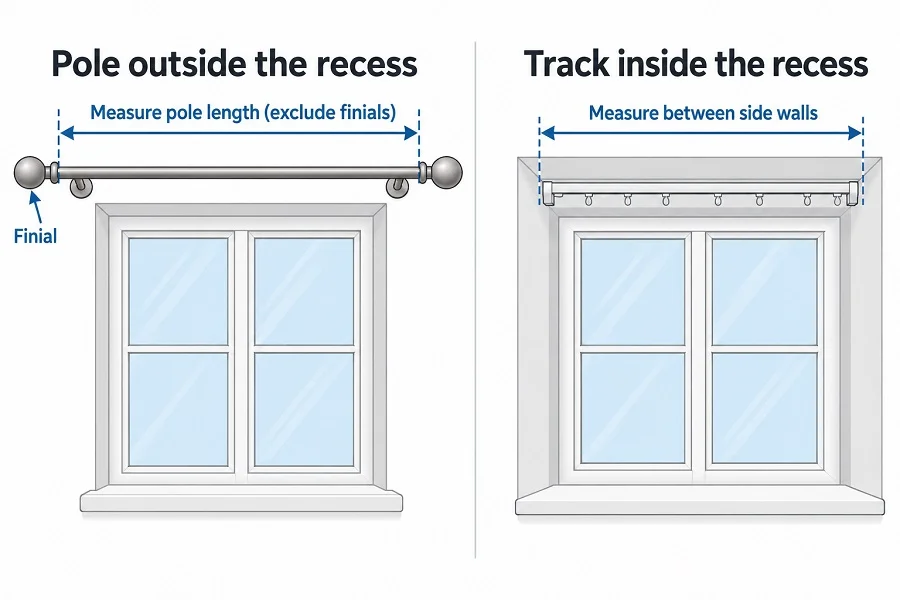
Some windows sit in a recess, which is a box set back into the wall.
- Outside the recess (most common): The pole or track goes on the wall above the recess. Measure the recess width, then add the extra 15 to 30 cm (6 to 12 in) on each side.
- Inside the recess: The track or rod fits between the two side walls. Measure the width at the top, middle and bottom, and use the smallest number. Keep in mind that the curtains will cover part of the glass when they are open.
Step 2: How to Measure Curtain Drop
The drop is measured from a starting point at the top down to where you want your curtains to finish. The starting point depends on your curtain header, which we explain in Step 4.
Run the tape straight down, and keep it upright. Then do this:
- Measure in three places: left, middle and right. Floors and sills are rarely perfectly level.
- Use the shortest number. This stops your curtains from dragging on the floor at the low point.
- Wait for new flooring. If new carpet or wooden floors are going in, measure after they are fitted. A thick carpet can change your drop by a centimetre or more.
Step 3: Choose Where Your Curtains Will End
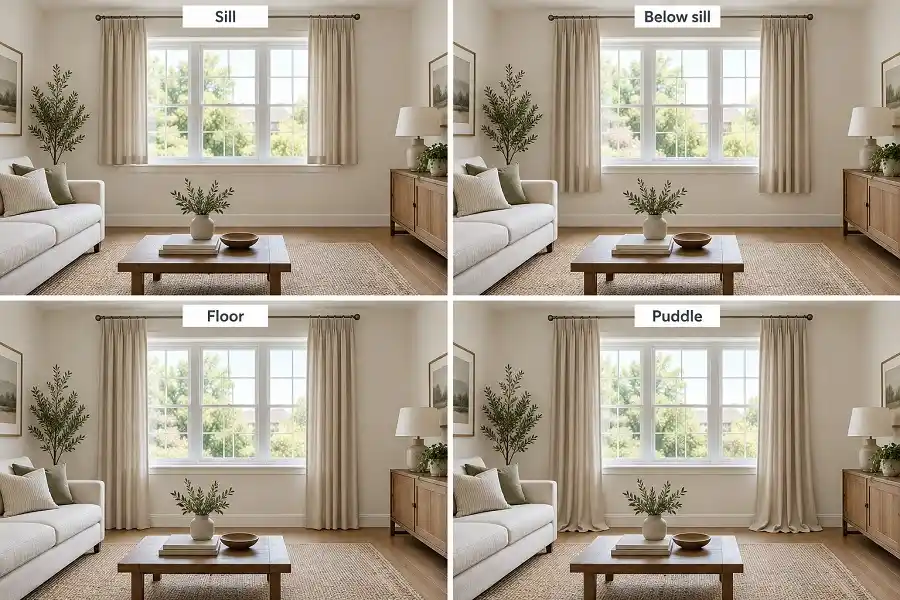
Before you write down your final drop, decide how long you want your curtains to be. There are four standard curtain lengths.
| Curtain length | Where it ends | How to adjust your measurement | Best for |
| Sill length | Just above the window sill | Measure to the sill, then take off about 1 cm (½ in) | Kitchens, bathrooms, small windows |
| Below sill (apron) | About 15 cm (6 in) below the sill | Measure to the sill, then add 15 cm (6 in) | Windows with a radiator underneath |
| Floor length | Just above the floor | Measure to the floor, then take off about 1 cm (½ in) | Living rooms, bedrooms, patio doors |
| Puddle | Pools gently on the floor | Measure to the floor, then add 2 to 7 cm (1 to 3 in) | Formal rooms with little foot traffic |
Floor length is the most popular choice. It makes ceilings feel higher and windows look bigger.
Puddle curtains look luxurious, but be honest with yourself about upkeep. They gather dust and pet hair, and you need to rearrange the folds each time you close them. They are not a good fit for kitchens, kids’ rooms or busy walkways.
Step 4: Where to Measure the Drop From (By Header Type)
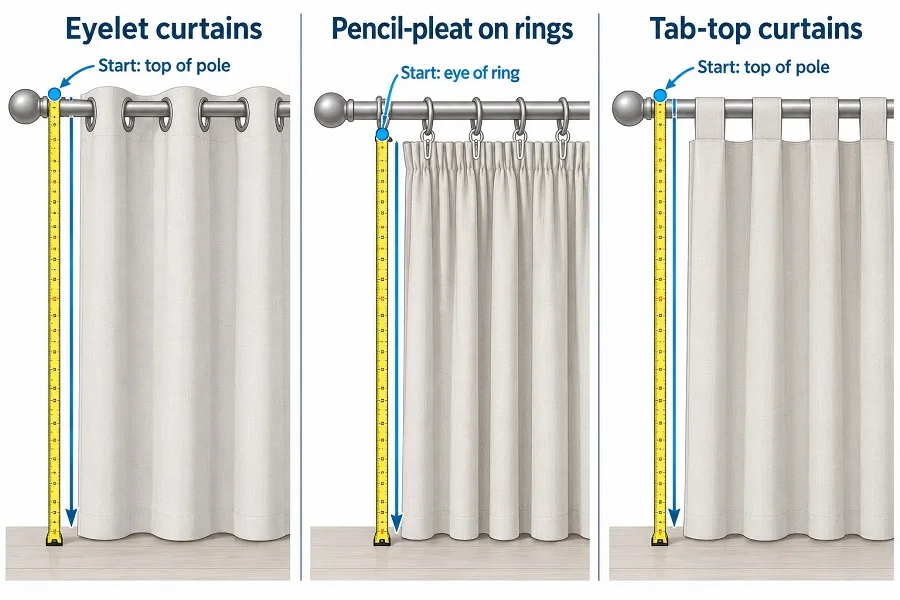
The header is the top part of the curtain that attaches to your pole or track. Each type hangs a little differently, so your drop starts from a different point.
| Header type | Start your drop measurement at | Good to know |
| Eyelet (grommet) | The top of the pole | Ready-made eyelet curtains are sized this way. If you are sewing your own, add extra for the fabric that stands above the pole, often about 3 cm (1 in). |
| Pencil pleat on a pole | The eye of the curtain ring (the small loop the hook goes into) | The curtain hangs just below the pole, so the pole stays on show. |
| Pencil pleat on a track | The top of the track | The pleated header can sit in front of the track and hide it. |
| Pinch pleat | Pole: the eye of the ring. Track: the top of the track | Often made to measure. Follow your maker’s guide if it asks for a different point. |
| Tab top or back tab | The top of the pole | The tabs loop over the pole. Check the tab length on the product page. |
| Slot top (rod pocket) | The top of the pole | The pole slides through a fabric sleeve. Common on voiles and sheers. |
| Wave (S-fold) | The top of the track | Almost always made to measure on a special track. Use the maker’s own guide. |
Not sure? Check the product page before you buy. Most shops say exactly where their drop is measured from.
How Much Wider Should Curtains Be Than the Window?
Curtains need more fabric than the width of your pole. Without it, they look flat and thin when closed, and light leaks through the gaps. This extra fabric is called fullness or gather.
| Look you want | Fullness | What it means |
| Light and casual | 1.5 times the pole width | Fine for eyelet, tab top and sheer curtains |
| Standard | 2 times the pole width | Suits most rooms and most ready-made curtains |
| Full and luxurious | 2.5 times the pole width | Deep folds, heavy fabrics, formal rooms |
To find the width of each curtain in a pair, use this formula:
\text{Width of each curtain} = \frac{\text{Pole width} \times \text{Fullness}}{2}
Example: Your pole is 150 cm (59 in). For a standard look, 150 × 2 = 300 cm of fabric in total. Split across two curtains, each one should be at least 150 cm (59 in) wide.
This gives you a simple rule of thumb: for a standard look, each curtain in a pair should be about as wide as your pole.
Watch out: Ready-made curtain widths are usually given per curtain, not for the pair. A pair of 168 cm (66 in) curtains gives you 336 cm (132 in) of fabric in total. In the UK and Europe, curtains are often sold in pairs. In the US, they are usually sold as single panels, so you buy two or more.
Stack-Back: Why Your Pole Should Be Wider Than the Window
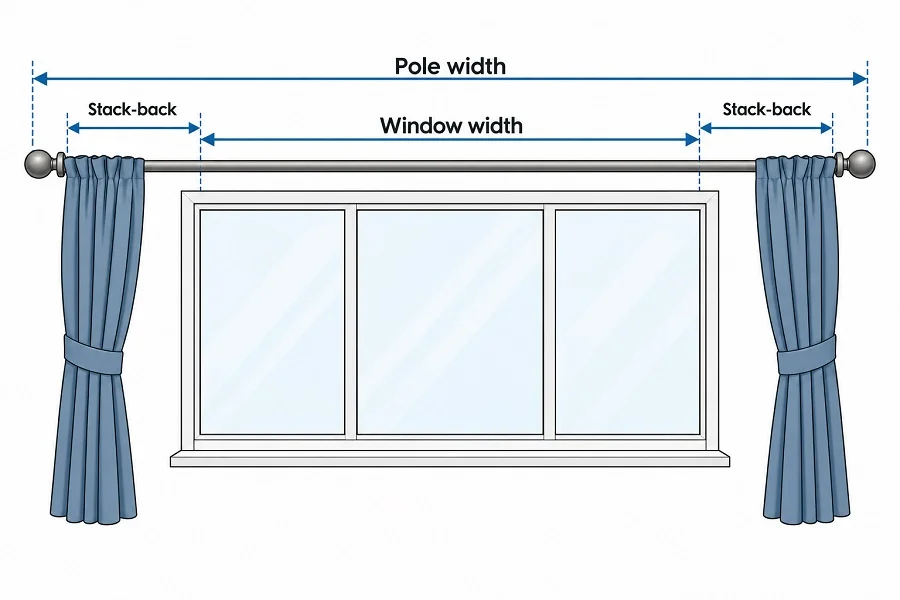
When you open your curtains, the fabric does not disappear. It folds into a bunch at each side. This bunch is called the stack-back.
Thick, lined and blackout curtains stack wider than light sheers. One curtain maker’s rule of thumb is that the stacked fabric takes up about 30% of the track width.
Example: A 200 cm (79 in) track would have about 60 cm (24 in) of stacked fabric when open. With curtains that open from the middle, that is about 30 cm (12 in) on each side.
If you want the glass fully clear when the curtains are open, extend your pole past the window by about that much on each side. For most windows, 15 to 30 cm (6 to 12 in) on each side does the job. Heavy curtains on wide windows may need a little more.
Standard Curtain Sizes in cm and Inches
Ready-made curtains come in set sizes. These sizes are different in different countries, so check which system your shop uses.
UK and Europe: standard curtain widths
These widths are per curtain. They are usually sold as a pair.
- 117 cm (46 in)
- 168 cm (66 in)
- 229 cm (90 in)
Standard curtain drop sizes in cm (UK and Europe)
| Drop in cm | Drop in inches | Often used for |
| 122 cm | 48 in | Small windows, kitchens |
| 137 cm | 54 in | Sill length on most standard windows |
| 183 cm | 72 in | Below sill on tall windows, or floor length on low windows |
| 229 cm | 90 in | Floor length in many homes, patio doors |
| 274 cm | 108 in | High ceilings and extra-tall windows |
Door curtains usually come in 117 cm (46 in) or 168 cm (66 in) widths with a 213 cm (84 in) drop.
Why do the numbers look slightly different between shops? Sizes start in inches and get converted to cm. Some shops round 72 in to 182 cm and others to 183 cm. Some say 228 cm, others 229 cm. They are the same size.
US: standard curtain sizes
In the US, curtains are usually sold as single panels. Panel widths often range from about 42 to 54 in (107 to 137 cm). Standard lengths are:
| Length in inches | Length in cm | Often used for |
| 63 in | 160 cm | Sill or below sill on standard windows |
| 84 in | 213 cm | Floor length on lower windows and doors |
| 95 or 96 in | 241 or 244 cm | Floor length with standard 8 ft ceilings |
| 108 in | 274 cm | High ceilings, poles mounted high |
| 120 in | 305 cm | Very tall or double-height windows |
Free Curtain Size Calculator
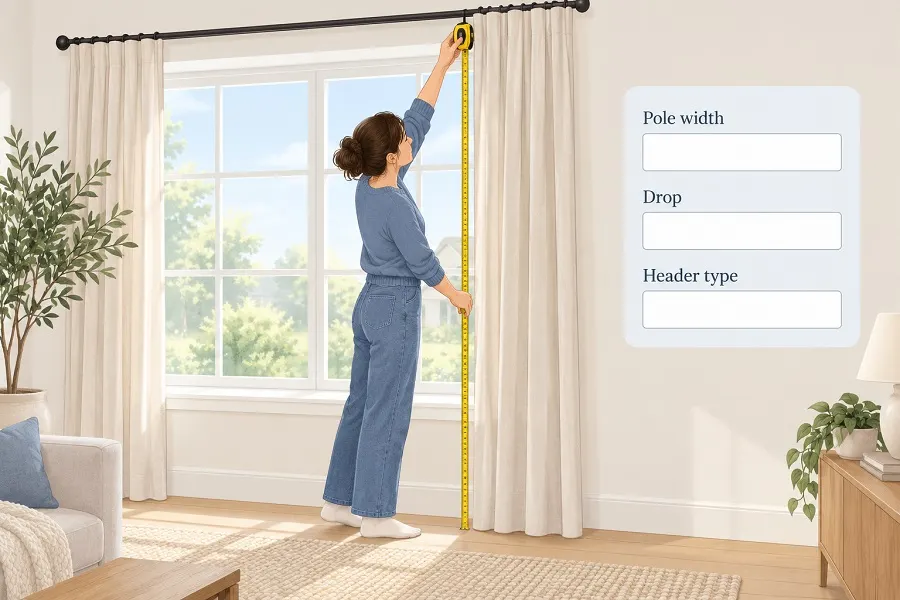
Not a fan of maths? Use our calculator. Enter your pole width and drop, pick your header and length, and it will show the curtain size you need.
Curtain Size Calculator
Enter your measurements and we will work out the curtain size you need.
How to Pick the Right Ready-Made Curtain Size
Your measurements will rarely match a ready-made size exactly. Here is how to choose.
- Width: always round up. Pick the first size that is the same as or wider than your number. Curtains that are too narrow cannot be fixed. Curtains that are a bit too wide just look fuller.
- Drop: pick the closest size that is the same or a little longer. Long curtains can be taken up with a simple hem. Short curtains are much harder to fix.
- Small gaps at sill length are fine. A curtain that stops 2 or 3 cm (about 1 in) above the sill still looks neat. A gap at floor length is much easier to spot.
- Go made to measure when nothing fits. If your window is very wide, very tall or an odd shape, made to measure curtains will fit far better than a ready-made pair.
Curtain Measurement Examples
Here is how real curtain measurements turn into a shopping list.
Example 1: Bedroom window, eyelet curtains, sill length
- Pole width without finials: 160 cm (63 in).
- Standard fullness: 160 × 2 = 320 cm. Each curtain needs to be 160 cm wide.
- Round up to the next ready-made width: 168 cm (66 in).
- Drop from the top of the pole to the sill: 141 cm, 140 cm and 140.5 cm. Use the shortest: 140 cm.
- Sill length means taking off about 1 cm: 139 cm.
- The closest standard drop is 137 cm (54 in). It stops about 3 cm above the sill, which looks fine at this length.
You need: one pair of eyelet curtains, 168 cm wide × 137 cm drop (66 × 54 in).
Example 2: Living room, pencil pleat on a track, floor length (US sizes)
- Track width: 100 in (254 cm).
- Standard fullness: 100 × 2 = 200 in of fabric in total.
- With 50 in wide panels, that is 200 ÷ 50 = 4 panels, two on each side.
- Drop from the top of the track to the floor: 97 in, 96.5 in and 97 in. Use the shortest: 96.5 in.
- Floor length means taking off about ½ in: 96 in.
You need: four panels, 50 in wide × 96 in long (127 × 244 cm).
Example 3: Patio door with no pole fitted yet
- Door frame width: 180 cm (71 in).
- Add 20 cm (8 in) on each side for stack-back: pole width = 220 cm (87 in).
- Plan to fit the pole 15 cm (6 in) above the door frame. Mark that height with a pencil.
- Standard fullness: 220 × 2 = 440 cm. Each curtain needs to be 220 cm wide, so choose 229 cm (90 in).
- Drop from the pencil mark to the floor (eyelet curtains, so measured from the top of where the pole will sit): 230 cm.
- Floor length means taking off about 1 cm: 229 cm, which matches the 229 cm (90 in) standard drop.
You need: a 220 cm pole and one pair of eyelet curtains, 229 × 229 cm (90 × 90 in).
How to Measure for Curtains on Tricky Windows
Bay windows
Fit your bay pole or track first. These bend to follow the shape of the bay, so measuring before it is up is guesswork.
- Angled bay: measure each straight section, then add them together.
- Curved bay: run a soft tape along the track. No soft tape? Lay a piece of string along it, then measure the string.
- Drop: measure each section separately, as bay windows often vary. Use the shortest drop for each curtain.
Decide early if you want one pair that covers the whole bay or a separate curtain for each section. Many people choose made to measure for bays.
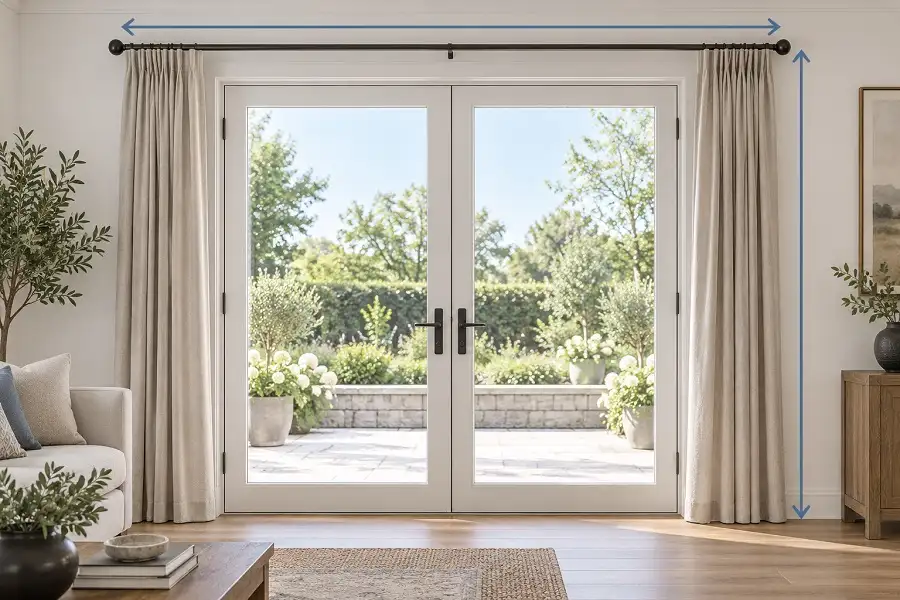
French doors and patio doors
Curtains on doors must clear the handle and the door swing. Make the pole wide enough for the curtains to stack fully off the door when open.
For floor-length door curtains, take off a little extra so the hem does not catch on the floor or threshold when the door moves.
Tall and floor-to-ceiling windows
For a dramatic floor-to-ceiling look, the track is often fixed to the ceiling. Measure from the ceiling down to the floor in three places. Old ceilings and floors are often uneven, so this check really matters here.
If you fix a pole to the wall just under coving or a cornice, leave a gap of at least 1 cm (½ in). The brackets need that space.
Windows with a radiator underneath
Long curtains over a radiator trap the heat behind them and send it towards the cold glass. Choose sill or below sill length instead, and measure to just above the top of the radiator.
Very wide windows
One pair may not be wide enough. In the UK and Europe, you can hang two pairs on one pole. In the US, simply add more panels. Long poles also need a centre bracket, so they do not sag.
9 Common Curtain Measuring Mistakes
- Measuring the glass instead of the pole or track.
- Including the finials in the width.
- Measuring the drop in only one place. Always check left, middle and right.
- Using a fabric tape measure that stretches.
- Measuring before new flooring goes down.
- Forgetting about fullness and buying curtains only as wide as the window.
- Mixing up per curtain and per pair sizes.
- Measuring the drop from the wrong point for your header type.
- Mixing up units. Write cm or in next to every number you take.
Printable Curtain Measuring Checklist
Print this or copy it to your phone before you start.
- Units I am using (cm or in): ______
- Pole or track width, without finials: ______
- Header type: ______
- Drop starting point: ______
- Drop on the left / middle / right: ______ / ______ / ______
- Shortest drop: ______
- Finish length (sill, below sill, floor or puddle): ______
- Final drop after adjusting: ______
- Fullness (1.5, 2 or 2.5 times): ______
- Width needed for each curtain: ______
Final Thoughts
Now you know how to measure for curtains the right way. Measure the pole, not the glass. Start your drop from the right point for your header. Check three places and use the shortest.
Add the right fullness, round your width up, and your curtains will look full, neat and made for your window.


